William Boose, Laney Graduate School PhD candidate in Anthropology, has been awarded a Fulbright U.S. Student Program award by the U.S. Department of State and the Fulbright Foreign Scholarship Board for the 2023-2024 academic year to study in Peru.
The Fulbright Program is the U.S. government’s flagship international educational exchange program and is supported by the U.S. and partner countries around the world. More than 2,000 diverse U.S. students, artists, and early career professionals in more than 100 different fields of study receive Fulbright U.S. Student Program awards annually to study, teach English, and conduct research overseas.
In his Fulbright-funded dissertation research in Peru, titled “Motorcycle Taxis and Urban Modernity: A Comparative Study in Lima and Iquitos,” Boose will critically study the governance of mototaxis (motorcycle taxis) as situated within broader notions of urban “modernity” and “development” in two cities.
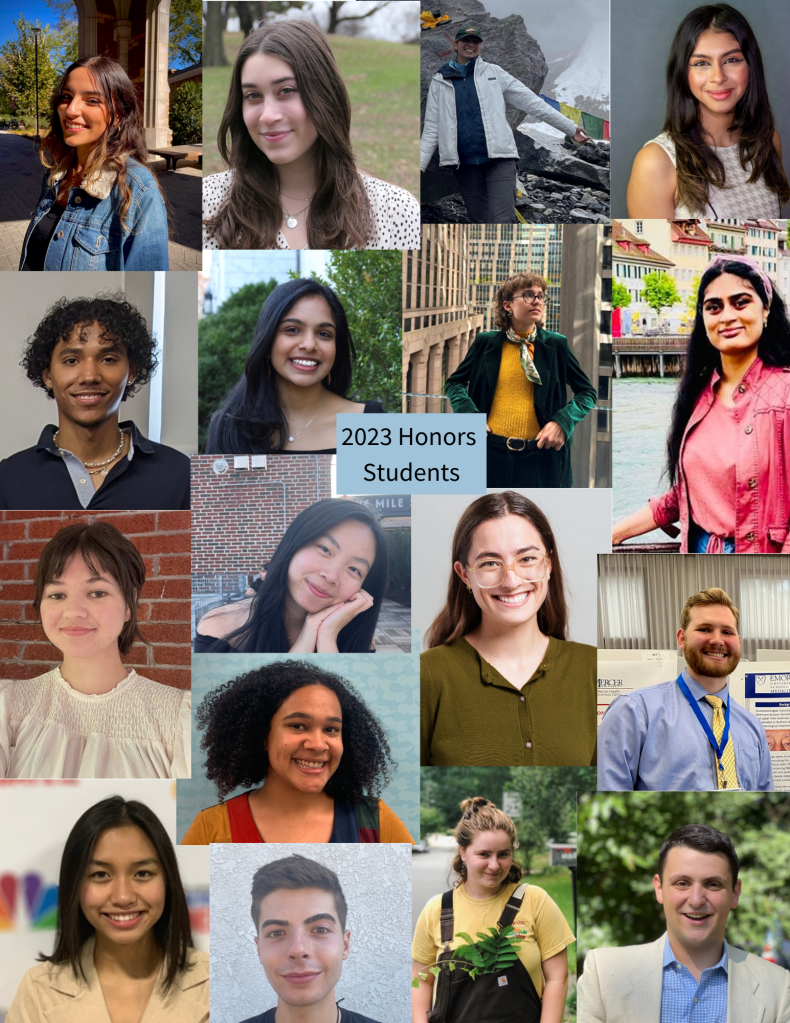
Congratulations to our 2023 Anthropology honors students! We wish you all the absolute best in your future endeavors!
You can read more about this year’s honors students and their projects on our 2023 Honor Students page.
Hunter Akridge Thesis Title: Contesting the Cultural Politics of Care: How Equitable Digital Care Platforms Reimagine the Future of Work
Rachel Broun Thesis Title: Enacting Solidarity and Negotiating Fictive Kinship: The Legal Consciousness of Black Women Working in the Criminal Legal System
Pamela Chopra Beniwal Thesis Title: The Effect of Commercialization, Militarization, and Stigmatization of the Breast Cancer Awareness Movement on Breast Cancer Patients
Lucia Buscemi Thesis Title: Footprints of the Roof of the World: Navigating the Impacts of Anthropogenic Activities in the Everest Region
Naomi Gonzalez-Garcia Thesis Title: Constellations of Un-Matter(ing) & Matter(ing) through Atlanta’s Black Spaces: Anthropological Perspectives on Housing and Relationality
Ruth Korder Thesis Title: Detecting Human Adaptations in Populations of the Andean Highlands
Danielle Mangabat Thesis Title: Confronting Colonial Legacies: Imagining a Decolonial Future in the Philippines through Reproductive Health
Natalie McGrath Thesis Title: Recentering the Voices of Pregnant-People and Birth Workers; Narratives of Childbirth
Atlas Moss Thesis Title: Vocal Recognition and Social Knowledge in captive Tufted Capuchin Monkeys (Sapajus apella)
Alvaro Perez Daisson Thesis Title: Race-related Health Disparities in the Context of COVID-19
Tanvi Shah Thesis Title: (Re)constructing Postpartum Depression (PPD) via Cross-Specialty Analysis and an Anthropological Lens of Subjectivity
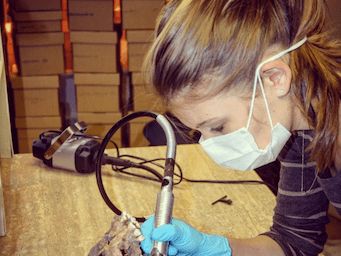
Krithika Shrinivas Thesis Title: Stone Tools and Sociality: Potential Effects of Conversation and Hobbies on Lithic Quality
Lizzy Wagman Thesis Title: Genome-wide patterns of selection in pre- and post-European contact Caribbean populations
Amy Wang Thesis Title: The Impacts of Social Media on Young Adults’ Body Images in the United States
Sam Weinstein Thesis Title: Vocal Clues to Diabetes Mellitus: Exploring the Ethics and Tech of AI in Clinical Practice
Gracie Wilson Thesis Title: The Culture of College Mental Health: Narratives of Stress, Value, and Belonging
Christopher Zeuthen Thesis Title: Qualitative Examination of Veteran Perspectives on Moral Injury
The Anthropology Department is pleased to announce our 2023 student award winners! For award descriptions and past winners, visit our Departmental Awards webpage. We are so proud of our many impressive students!
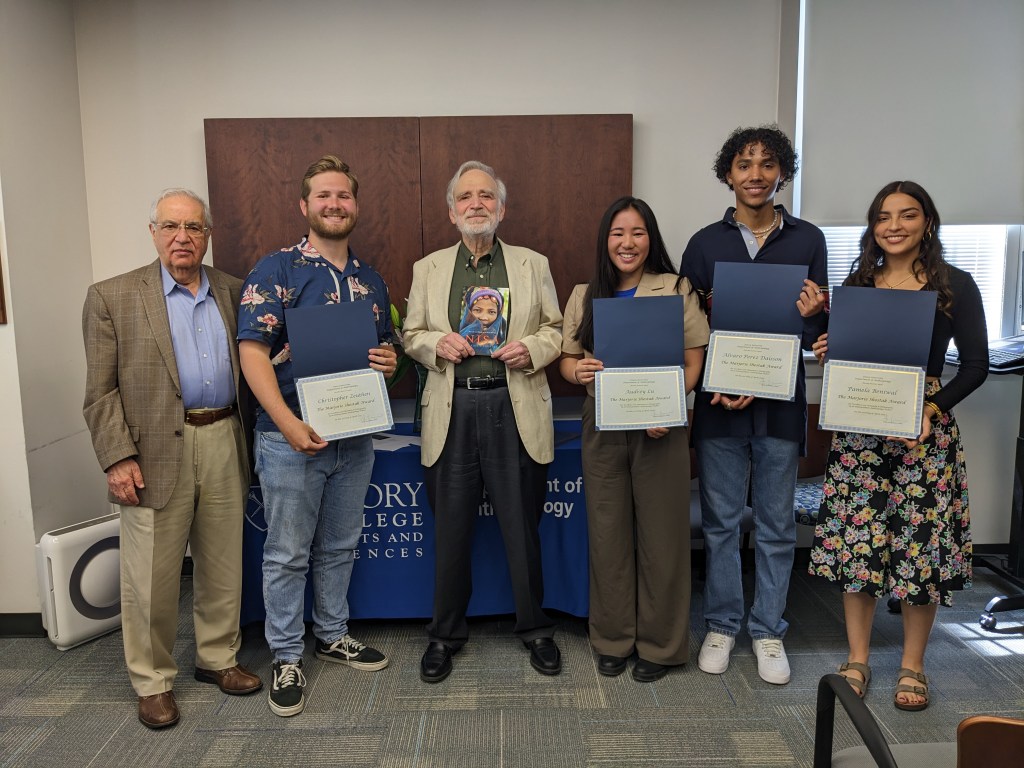
Marjorie Shostak Award for Excellence and Humanity in Ethnography:
Pamela Beniwal for her honors thesis “The Effect of Commercialization, Militarization, and Stigmatization of the Breast Cancer Awareness Movement on Breast Cancer Patients”, advised by Mel Konner.
Audrey Lu for her ANT 372W class project “The Lives of Charting: An Emergency Room Scribe’s Perspective (ANT 372W project)”, advised by Anna Grimshaw.
Alvaro Perez Daisson for his honors thesis “Race-related Health Disparities in Cuba in the Context of COVID-19”, advised by Mel Konner and Kristin Phillips.
Christopher Zeuthen for his honors thesis “Veteran Perspectives on Moral Injury”, advised by Mel Konner.
Photo from left to right: Professor Robert Paul, Christopher Zeuthen, Professor Melvin Konner, Audrey Lu, Alvaro Perez Daisson, and Pamela Beniwal.
Trevor E. Stokol Scholarship for Undergraduate Research:
1st Place: Eric Li
Maddie Hasson
Raya Islam (not pictured)
2023 Graduate Student Awards
The George Armelagos Award for Excellence in Teaching by a Graduate Student: AJ Jones, Caroline Owens
The Lindo lab specializes in mapping little-explored human lineages of the Americas.
Previously published research found evidence of the tuberculosis bacterium in the skeletal material of 1,400-year-old Andean mummies, contradicting some theories that TB did not exist in South America until the arrival of Europeans 500 years ago.
The current paper provides the first evidence for a human immune-system response to TB in ancient Andeans and gives clues to when and how their genomes may have adapted to that exposure.
Among the strongest signals detected were for biomarkers that are switched on in modern humans during an active TB infection. The researchers modeled the timing of selection for several of the genes involved in the TB-response pathways. Although they were not as strong as for exposure to TB, some signals were also detected for biomarkers related to adaptation to hypoxia, or low levels of oxygen in the blood that result from living at high altitude.
“Human-pathogen co-evolution is an understudied area that has a huge bearing on modern-day public health,” Sophie Joseph says. “Understanding how pathogens and humans have been linked and affecting each other over time may give insights into novel treatments for any number of infectious diseases.”
In 2002, armed Hindu mobs attacked Muslims in broad daylight in the west Indian state of Gujarat. The pogrom, which was widely seen over television, left over one thousand dead. In Composing Violence, Moyukh Chatterjee examines how highly visible political violence against minorities acts as a catalyst for radical changes in law, public culture, and power. He shows that, far from being quashed through its exposure by activists, media and politicians, state-sanctioned anti-Muslim violence set the stage for transforming India into a Hindu supremacist state. The state and civil society’s responses to the violence, Chatterjee contends, reveal the constitutive features of modern democracy in which riots and pogroms are techniques to produce a form of society based on a killable minority and a triumphant majority. Focusing on courtroom procedures, police archives, legal activism, and mainstream media coverage, Chatterjee theorizes violence as a form of governance that creates minority populations. By tracing the composition of anti-Muslim violence and the legal structures that transform that violence into the making of minorities and majorities, Chatterjee demonstrates that violence is intrinsic to liberal democracy.
“In this powerful book, Moyukh Chatterjee gives us a brief, elegant, and novel way of thinking about violence.” – Nancy Rose Hunt, author of Nervous State: Violence, Remedies, and Reverie in Colonial Congo.
Available here! Use coupon code E23CHTTR to save 30% when you order from www.dukeupress.edu.
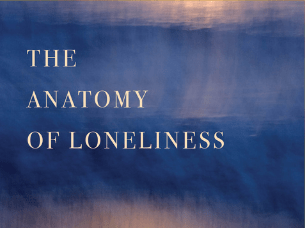
The Francis L. K. Hsu Prize is given to the book that was judged to have made the most significant contribution to the field of Anthropology of East Asia and is awarded by the American Anthropological Association’s Society for East Asian Anthropology. In The Anatomy of Loneliness, Ozawa-de Silva gracefully threads the needle of writing for a non-specialist audience while adding to conversations about loneliness, suicide, and social connection in the anthropology of East Asia. Moreover, she writes about the particularities of a social phenomenon in Japan in ways that speak to global experiences of loneliness as a part of the human condition, but one exacerbated by the structures of modern life and neoliberal policies. To do so, the book draws together current research in anthropology, sociology, psychology, and neuroscience/developmental biology, to theorize the anatomy of loneliness as both individual and social. The chapters chart Ozawa-de Silva’s research journey from a study of the dramatic increase in suicides in Japan beginning in 1998, to her discovery that a lack of social connection, loneliness, and a sense of meaning in life better reflected the stories she encountered than the assumed economic or mental health causes. In order to study suicide ethnographically, the book analyses first, second, and third person accounts seen through the phenomenon of suicide websites, the commodification of intimacy, the perceptions of college students, and the 2011 natural and nuclear disasters. The book ends with a timely focus on the communal loneliness of areas forgotten in post-Fukushima recovery initiatives and emerging examples of their resilience through community. Thus, Ozawa-de Silva writes about suicide and loneliness in Japan in ways that speak to wider global trends while giving us some hint at potentially better ways to live today. The committee also found Chikako’s book to be “poignant, richly ethnographic, and an exemplary instance of a book that really speaks beyond our field.”
The Victor Turner Prize in Ethnographic Writing is an annual juried book award by the American Anthropological Association’s Society for Humanistic Anthropology (SHA). The prize committee “seeks graceful, accessible ethnographic writing which deeply explores its subject and contributes in innovative and engaging ways to the genre(s) of ethnography and the field of humanistic (and/or post-humanistic) anthropology.” Chikako Ozawa-de Silva’s The Anatomy of Loneliness humanistically explores issues of human biology, and it analytically transforms loneliness from an individual state of being into a societal predicament. This book is a jarring, empathetic, and even paradoxical diagnosis of emerging collective social structures that make people feel alone. Along the way, readers are introduced to a brave and novel vision for what an inclusive society might mean. The book’s subject matter, from mental health to suicide, is challenging — but Ozawa-de Silva shows us how to rigorously write these topics in ways that cultivate inclusive engagement rather than reproduce the senses of alienation the book explores. The committee also felt that The Anatomy of Loneliness offers a truly unique, distinguished, and even experimental model of accessibility. This book is lucidly written. it is also a text that creatively and transparently brings the reader alongside the author in all her intellectual premises, all her conceptual inspirations, and every one of her turns of thought.
Watch Professor Ozawa-de Silva read the first 5-minutes of her book here.
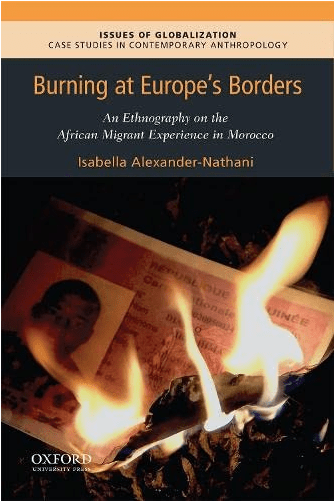
The Association for Africanist Anthropology has awarded Dr. Isabella Alexander the 2022 Elliott P. Skinner Book Award for her book Burning at Europe’s Borders.
This prize is awarded to the book that “best furthers both the global community of Africanist scholars and the wider interests of the African continent, with special consideration given to works drawing upon extensive research in Africa and advancing new methodologies for anthropological fieldwork in Africa.”
Dr. Alexander Hinton graduated in 1997 and majored in Psychology and Cultural Anthropology. His dissertation was on the Cambodian genocide. Today, he is a Distinguished Professor of Anthropology, Director of the Center for the Genocide and Human Rights, and UNESCO Chair in Genocide Prevention at Rutgers University, Newark. He is an award-winning author and editor of seventeen books, including most recently, Anthropological Witness: Lessons from the Khmer Rouge Tribunal (Cornell, 2022)—which focuses on his testimony as an expert witness at the Khmer Rouge Tribunal and his exchange with “Brother Number Two.”
The AIME award is reserved for persons who have “raised public awareness of anthropology and have had a broad and sustained public impact at local, national, and international level.” Congratulations Dr. Alexander Hinton!
Read more about the AAA 2022 Award Recipients here!
“Selling Industrial ‘Gallina Criolla’ Products in Guatemala” details these new corporate marketing tactics of competing with gallina criolla economies of indgenous and peasant peoples. The report begins by summarizing the latest science on the economic, ecological, social, nutritional, and taste differences between gallina criolla and industrial chicken. It shows that the gallinas criollas that emerge from campesina systems of production are different animals than the industrial chickens that emerge from industrial systems of production. The methods of rearing involved, the ecological and economic functions the birds perform, and the nutritional value and taste of the chicken meat from the two systems are not the same. At the same time, while gallina criolla production is one part of agroecological systems that tend towards diversity, industrial production of commercial chickens tends towards homogeneity.
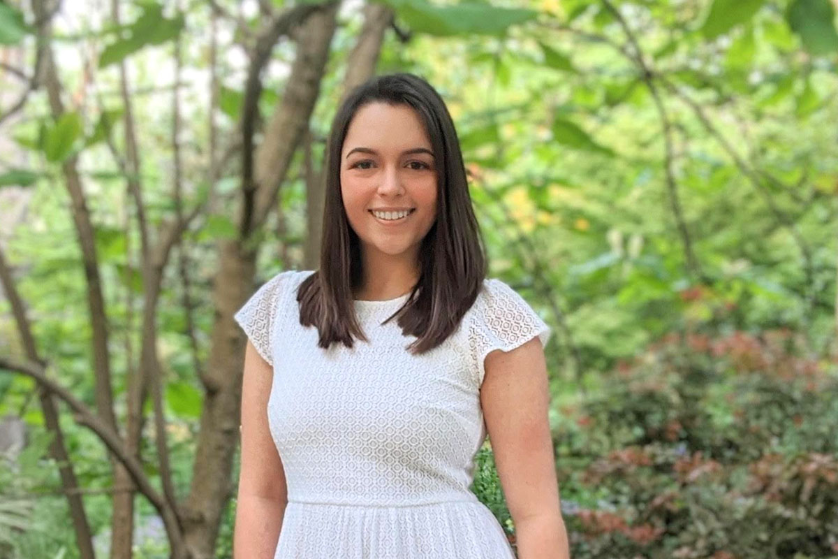
Dr. Sirak received her PhD in 2018 for her dissertation on “A Genomic Analysis of Two Early Christian Cemetery Communities from Sudanese Nubia”, she is now a staff scientist at Harvard University. Her research bridges the fields of Ancient DNA and archaeology and helps shed light on social structures as well as the genomes of ancient populations.







 EMORY ANTHROPOLOGY