
Emory Magazine reported about several Emory Global Health Institute projects, including the work of then graduate student Bonnie Kaiser (PhD, Emory Anthropology; MPH) on mental health issues in Haiti.
Category: Biological Anthropology
Professor Todd Preuss featured on NPR
An article featured on NPR discusses the complications that arise when rodents are commonly used to test medications intended for humans: namely, a disappointingly high failure rate once medications are tested on human subjects.
Todd Preuss, an anthropologist at the Yerkes National Primate Research Center at Emory University and Associated Professor of Anthropology, indicates that rats were initially studied to learn about rats. At some point they transitioned to “prototypical mammals.” Dr. Preuss points out that rodents have not only developed quite differently from humans, but the specific test subjects can also be described as lacking genetic diversity.
Emory Anthropologists preparing for Archaeological Excavation in Jordan
Dr. Liv Nilsson Stutz (Emory Anthropology) and Dr. Aaron Stutz (Emory Anthropology at Oxford), along with Chantel White (Penn Museum) and a team of graduate and undergraduate students are preparing for their second round of excavations at the Mughr el-Hamamah site in Jordan. Dr. Nilsson Stutz talks about the well-preserved paleolithic plant remains at the site and describes the possibilities:
“We hope that the careful recovery of these unique remains and the following analysis of them will allow us to better understand how palaeolithic hunters and gatherers used plants for food, shelter and tool making during the period that coincides with the replacement of neanderthals by Anatomically Modern Humans in Western Eurasia. This is a very rare site, and we really think our work will be able to fill in some gaps in our understanding of palaeolithic hunter gatherer ecology, subsistence, and the demographic changes at this crucial point in human evolution.”
The project is entering its final stages of fundraising. For more information or to help crowd fund, please visit this website.
Dr. James Rilling: correlation between paternal nurturing and oxytocin

Emory’s eScience Commons reported on Dr. James Rilling’s research at the Laboratory for Darwinian Neuroscience. In order to study the neurological reasons for differing care-giving behaviors, Dr. Rilling administered either oxytocin or a placebo to fathers of toddlers. When shown photos of their child, those fathers who had received the oxytocin showed increased neural activity in areas of the brain that are associated with reward and empathy.
Bioarcheologist Clara Alfsdotter is visiting the Anthropology Department at Emory for research

Photo by Daniel Lindskog

Photo by Daniel Lindskog
Clara Alfsdotter is a PhD student at Linneaus University in Sweden and an archeologist at the Bohusläns County Museum in Uddevalla.
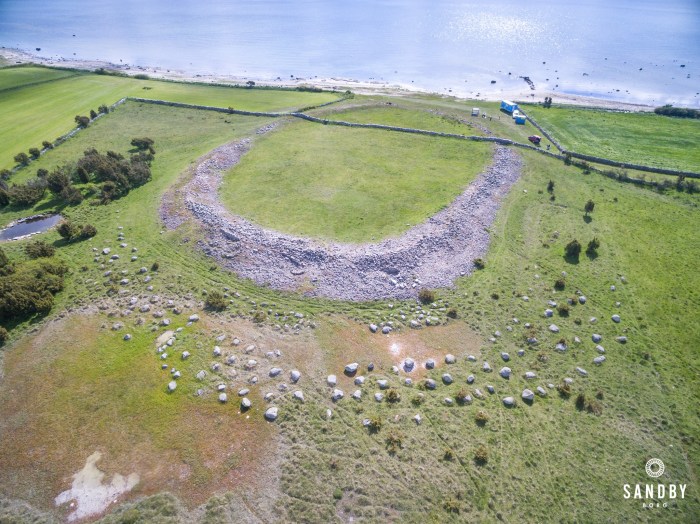
She is working on the excavation site of Sandby Borg, a ring fort on the Baltic island of Öland in Sweden. Excavation is still in the early stages, but fascinating puzzles are already emerging. It seems that the inhabitants were brutally killed while many valuables such as gold, roman artifacts, and animals were left behind and were not looted afterwards.
“It’s intriguing that no females have been found yet,” says Alfsdotter. This absence ties into the questions of how and why this happened and makes the experts wonder what happened since. On top of these mysteries this site is also an exceptional and rare record of the Migration period life inside a ring fort – since the fort was abandoned after the assault, everything has just been left to decay inside the houses and on the streets after that day. Extraordinary details of the everyday life are found. For example, next to one house hearth, the skeletal remains of half a herring was discovered. Was someone brutally interrupted when preparing the food that day 1500 years ago?
Alfsdotter’s focus for this trip is research on learning and developing methodologies and theories for tracing the original position of the human bodies and why they came to rest in the way they did. What was the original position of the corpse and why? Can the acts of the perpetrators and victims be traced? Alfsdotter is at Emory University visiting Dr. Liv Nilsson Stutz, who has a long history of archaeothanatological research into how skeletal remains have been affected by taphonomic processes and mortuary circumstances.
Dr. Adrian Jaeggi’s Research featured on Emory’s eScience Commons
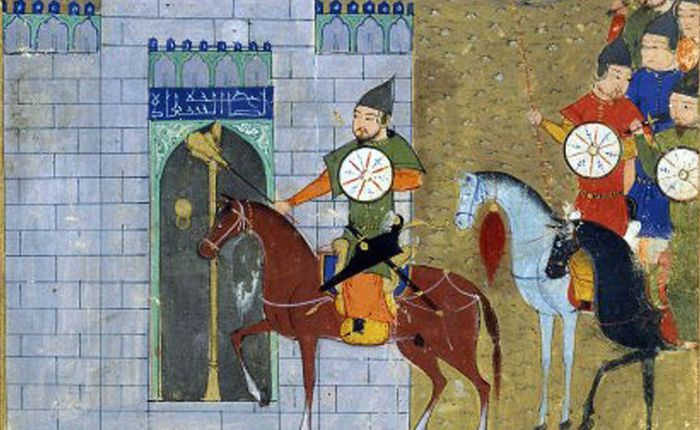
Dr. Adrian Jaeggi’s work studying the relationship between male social status and reproductive success in non-industrial societies has been featured in Emory’s eScience Commons.
“We were surprised to learn that the correlation held up for a range of societies and their different measures for status,” says Adrian Jaeggi, an anthropologist at Emory University focused on primate and human behavioral ecology. “It doesn’t matter whether a man is a better hunter, owns more land or more livestock – men with high social status had more children compared to men with low status.”
Grace Veatch appears in a video on Research on Faunal Remains
Graduate student Grace Veatch spent last spring break attending the Liang Bua Workshop at the University of Wollongong, Australia, where researchers examined faunal remains. This video provides a glimpse into her interesting work.
Kendra Sirak’s Research on Ancient DNA Featured in Emory News
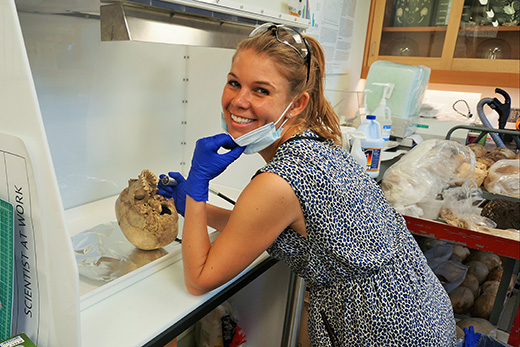
This Summer, Anthropology PhD candidate Kendra Sirak’s research was featured in Emory News. Kendra is a visiting researcher at the Earth Institute at University College Dublin, where she is testing the DNA of people ranging from medieval Nubians to an ancient Chinese specimen to an Irish rebel.
Kendra describes her anthropological training at Emory:
“At Emory, I have learned how to think from a “biocultural” point of view. While many other anthropology programs stress only either a “biological” or a “cultural” approach, Emory combines the two.
I study the biology of past populations and I think about the way their culture and social environment could have influenced individual health and well-being, population demographics, patterns of morbidity and mortality, etc.”
 EMORY ANTHROPOLOGY