Anthropology Alumni Daniel Thompson publishes book: Smugglers, Speculators, and the City in the Ethiopia-Somalia Borderlands

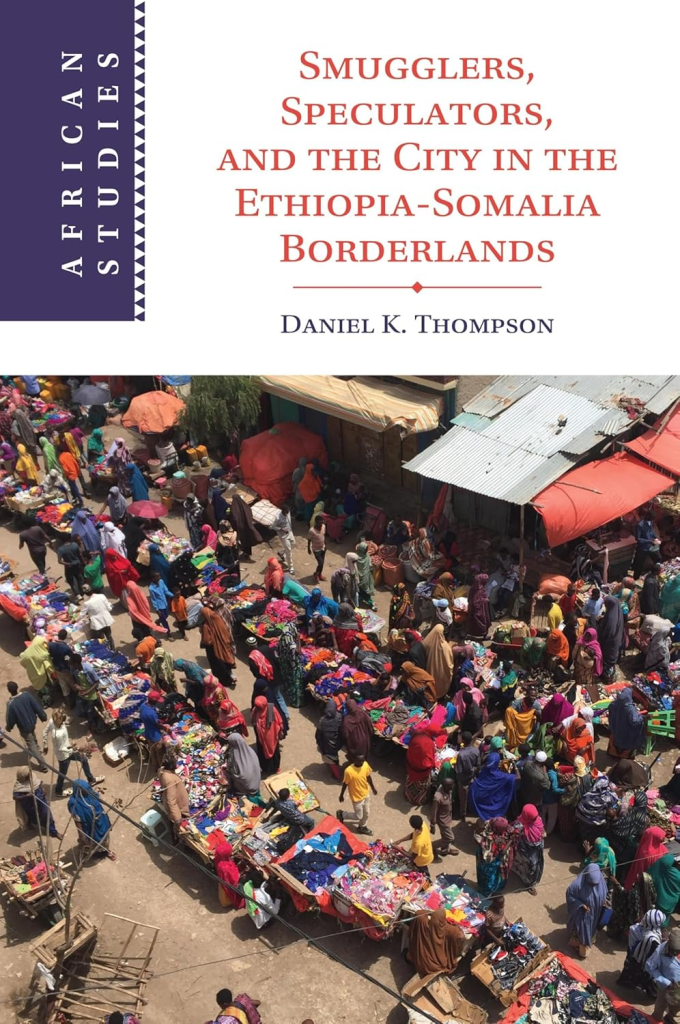
Emory University and Anthropology Alumni Daniel K. Thompson publishes book titled Smugglers, Speculators, and the City in the Ethiopia-Somalia Borderlands.

Daniel graduated from Emory University with his PhD in 2019 and is now an Assistant Professor of Anthropology at the University of California, Merced. His research focused on exploring eastern African and US migration, border-making and how urbanization shaped economic strategies for handling uncertainty.

First page excerpt: “For a century, the Ethiopian city Jigjiga was known as a dusty hub of cross-border smuggling and a hotbed of rebellion on Ethiopia’s eastern frontier. After 2010, it transformed into a post-conflict boomtown, becoming one of Africa’s fastest-growing cities and attracting Somali return-migrants from across the globe. This study examines Jigjiga’s astonishing transformation through the eyes of its cross-border traders, urban businesspeople, and officials. Daniel K. Thompson follows traders and return-migrants across borders to where their lives collide in the city. Analysing their strategies of mobility and exchange, this study reveals how Ethiopia’s federal politics, Euro-American concerns about terrorism, and local business aspirations have intertwined to reshape links between border-making and city-making in the Horn of Africa. To understand this distinctive brand of urbanism, Thompson follows globalized connections and reveals how urbanites in Africa and beyond participate in the “urban borderwork” of constructing, as well as contesting, today’s border management regimes.”

Smugglers, Speculators, and the City in the Ethiopia-Somalia Borderlands by Daniel K. Thompson is available for purchase online.

Congratulations to graduate student Sasha Tycko for her “Not One Tree”

Photo of Sasha by Peter Habib

Anthropology graduate student Sasha Tycko was awarded the Krause Essay Prize from the University of Iowa’s Nonfiction Writing Program for her essay, “Not One Tree“.

“Sasha Tycko is an anthropologist and artist working on a PhD at Emory University. Her research focuses on the Atlanta forest at the center of the conflict over “Cop City,” using a range of media to explore how the contested landscape motivates new articulations of history, nature, and ethics. Through this work, she has produced two films, Dwelling: A Measure of Life in the Atlanta Forest and Atlanta Forest Garden: Four Days of Work, and a photography exhibition, “Ways of the Atlanta Forest.”

The Krause Essay Prize is awarded annually to the work that best exemplifies the art of essaying. Nominations for the Krause Essay Prize are made each year by a committee of writers, filmmakers, radio producers, visual artists, editors, and readers. 

Congrats Sasha!

Anthropology graduate student, Peter Habib, awarded Middle East Studies Association 2024 Graduate Student Paper Prize.

Contaminating Humanitarianism: Cholera, Nationalism, and the (Un)Regulated Life of Syrians in Lebanon

The MESA Graduate Student Paper Prize was established in 2004 and first given in 2005. The purpose of the award is to recognize the work of young scholars. The award is given to the paper that shows the best control of the subject matter and adept methodology, good use of sources and evidence, coherence and elegance of argument and good writing.

Read Peter Habib’s award announcement here!

Visiting Assistant Professor and PhD alumnus Nikola Johnson awarded 2024 Wenner-Gren Hunt Postdoctoral Fellowship Grant

Anthropology Visiting Assistant Professor Nikola Johnson was awarded the 2024 Wenner-Gren Hunt Postdoctoral Fellowship Grant to support 9 months of writing to complete a monograph based on research conducted for his dissertation, titled Emergent Citizenships: Mapuche (Indigenous) and Chilean (non-Indigenous) Politics and Belonging in peri-urban Santiago, Chile. 

Professor Johnson said of his project, “This book project explores how the politics of autogestión have led to the emergence of democratic frameworks that contrast with liberal representational democracy in a globalized, neoliberal era. Frequently translated as “self-help”, contemporary scholarship has often distorted the concept of autogestión by analyzing community care practices as responses to neoliberal restructurings or products of neoliberal governmentality. In contrast, my research found that the concept of autogestión is more accurately understood as “lived democratic practice” and traces its origins to the 1960s “People Power” movements in North America and Europe, Latin American Third Worldism, and African decolonization. It draws from my 30 months of ethnographic and archival research which found that the transnational discourse of autogestión influenced the practices of democracy during Chile’s Social Explosion (October 2019), ongoing COVID-19 Pandemic (March 2020-present) and failed process to re-write the constitution written during the Pinochet Dictatorship (October 2022-December 2023). Through situating this Chilean case study within a global assemblage of social movements from the 1960s to the present, this project contributes to the broader anthropological theory of politics by scaling down its analysis to the level of everyday life to analyze where, when, and through whom democratic practices are exercised.”

Congratulations Nikola Johnson!

Two Row Repair: A Trilogy, a poem by Professor Debra Vidali is published in the American Anthropological Society journal, Anthropology and Humanism.

Anthropology Professor Debra Vidali poem, Two Row Repair: A Trilogy, which is featured in the March 2024 issue of the American Anthropological Association journal, Anthropology and Humanism. An abstract and early view of the poem can be accessed on the online library, AnthroSource and a journal issue will be available in the Emory University library later this Spring. Vidali received first place in the 2023 Society for Humanistic Anthropology’s 37th Annual Ethnographic Poetry Competition for Parts II and III of this trilogy.

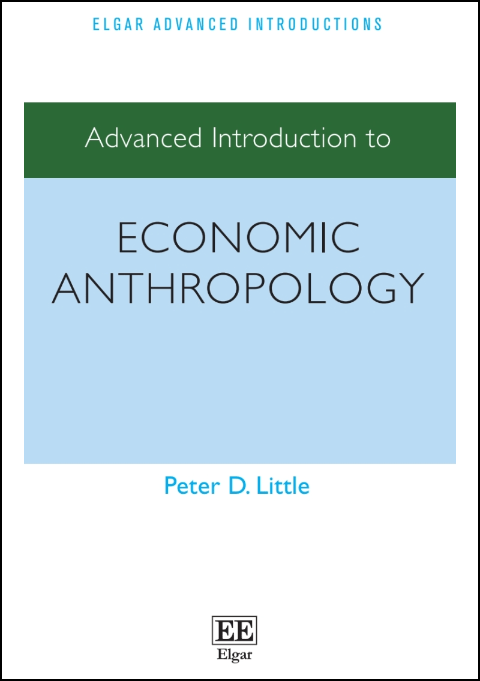
New book by Professor Peter Little is now available: “Advanced Introduction to Economic Anthropology”

Professor Peter D. Little, Samuel Candler Dobbs Professor of Anthropology and Director of Global Development Studies, recently published a book titled, Advanced Introduction to Economic Anthropology

The book illustrates how an anthropological perspective can deepen understandings of customary and global markets; different types of money; diversified livelihoods of the poor; gendered and racialized labor; climate change and other global issues. By questioning common dichotomies, such as the informal versus formal sectors and customary versus modern institutions, the book uncovers those hidden connections, power relations, and economic actors and processes that underpin real economies throughout the world.

Get up to 20% discount when you order online at Edward Elgar Publishing.
You may also purchase a copy from Amazon.

Congratulations to Dr. Peggy Barlett for receiving AASHE Lifetime Achievement Award

On December 7th, Dr. Peggy F. Barlett, Goodrich C. White Professor Emerita of Anthropology, received the AASHE Lifetime Achievement Award for her dedication to sustainability in higher education. Dr. Barlett was instrumental in the founding of Emory’s Piedmont Project, training over 640 faculty members from 350+ institutions, and catalyzing a widespread adoption of sustainability-focused curriculum across these institutions. 

Her impact extends beyond academia, shaping Emory’s sustainable food initiatives and achieving significant milestones in campus dining sustainability. As a respected author and leader in sustainable education, Dr. Barlett’s contributions span many influential publications and articles.

Read more about Dr. Barlett’s work here.

Emory Anthropology Alumnae Joanna Davidson ’07 and Dinah Hannaford ’14 edit volume publication, Opting Out: Women Messing with Marriage around the World.

Emory Anthropology alumnae Joanna Davidson ’07 and Dinah Hannaford ’14 joined forces to publish an edited volume, Opting Out: Women Messing with Marriage around the World (Rutgers University Press 2022). The book gathers ethnographic accounts of women moving away from conventional marital arrangements in countries all over the world. From Brazil to Botswana, the contributors examine the conditions that make this widespread – although locally variable – phenomenon possible and consider what the implications of opting out might be, both for marriage itself and for the anthropological study of it.

Postdoctoral Graduate Scott Schnur published in Nature Energy for co-authored article, A Framework to Centre Justice in Energy Transition Innovations.

Postdoctoral Graduate, Scott Schnur collaborated with researchers from the National Renewable Energy Laboratory (NREL) and other universities published an article in Nature Energy titled A Framework to Centre Justice in Energy. In the article, Scott and his colleagues discuss the important role of community engagement as a tool to promote equity in the green Energy Transition. They propose a framework that developers, planners, government officials, and other stakeholders can use in order to promote energy justice and inclusivity in the critical work that lies ahead in transforming our grid and combating climate change. Scott says, “The article continues my interest in exploring ways to promote equity and justice in relation to emergent climate futures.”

Check out the write up from NREL here!

Dr. Peter Little co-authors Reconsidering Resilience in African Pastoralism: Towards a Relational and Contextual Approach

Dr. Peter Little, along with two other authors, recently published Reconsidering Resilience in African Pastoralism: Towards a Relational and Contextual Approach earlier this summer.

What does resilience mean? This is a question frequently asked and one that this book challenges and turns on its head. This book interrogates the increasingly overused concept of resilience by examining its application to a series of case studies focused on pastoralists in Africa. Through anthropological approaches, the book prioritises the localisation of resilience in context and practice; how to promote ‘thinking resilience’ in place of the typical ‘resilience thinking’ approach. Anthropology has the power to raise the vantage point of people and places, make them speak, breath, and live. And this gives to resilience more grounded and quotidian framings: local, relational, political and ever evolving. The authors ask whether development assistance and government intervention enhance the resilience of African pastoralists, while discussing critical topics, such as political power, land privatization, gender, human-animal identities, local networks, farmer-pastoralist relations, and norms and values. The epilogue, in turn, highlights important theoretical and empirical connections between the different case studies and shows how they provide a much more nuanced, culturally and politically meaningful approach to resilience than its common definition of ‘bounce back.’ By approaching resilience from relational and contextual perspectives, the book showcases a counter-narrative to guide more effective humanitarian and development framing and shed light on new avenues of understanding and practicing resilience in this uncertain world.

Purchase your copy from Amazon here!