Peter Little delivers the African Studies Review Distinguished Lecture at the 61st Annual Meetings of the African Studies Association (ASA), Atlanta, GA, November 30, 2018 The ASA is the largest professional association of African specialists in the world.
Author: emoryanthropology
Douglas Falen (92C) publishes new book on African Science


Dr. Justin Pargeter publishes research on prehistoric toolmaking
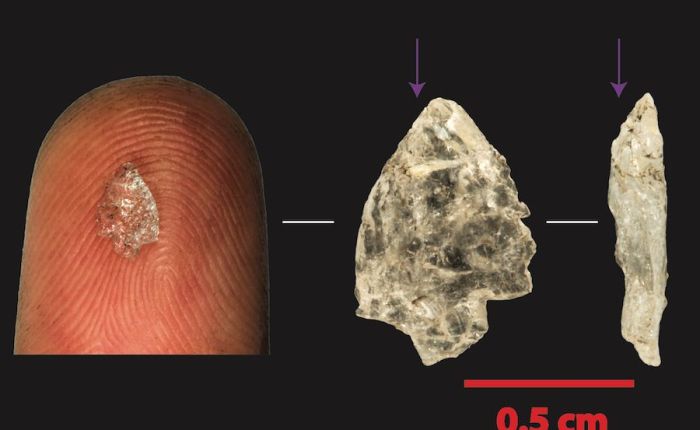
In a recent publication in the journal Antiquity, Justin Pargeter (a Postdoctoral researcher with Emory University’s Anthropology Department) argues the motivations of prehistoric hunter-gatherers for selecting particular rocks for toolmaking are often explained in too rigidly functional or symbolic terms. By examining the exploitation of crystal quartz at two archaeological sites (Ntloana Tšoana and Sehonghong) in Lesotho, southern Africa, he and his co-author Jamie Hampson (University of Exeter) reveal that stone tool production required a form of engagement unique to crystal quartz’s specific properties (including possibly quartz crystal’s piezoelectric effects). The prefered use of quartz crystals—irrespective of the availability of other rocks for tool production—demonstrates agency and variability in the prehistoric technologies.

Calling all knappers – Dr. Stout studies the connection between ancient stone tool-making and the human brain
Dr. Dietrich Stout is an experimental archeologist at the department of Anthropology where he researches connections between prehistoric stone tool-making, known as knapping, and the human brain. He has set up an online experiment in collaboration with Robert Rein at the German Sport University Cologne. Participants are asked to spend 10 minutes of their time to help deepen our understanding of the relationship between the visual-spatial skills used in knapping and areas of the brain that are involved in language processing. Dr. Stout is hoping to establish whether participants can differentiate size the of stone flakes removed during knapping, and how novice knappers fare in comparison to experts.
Read more about this on eScienceCommons and Dr. Stout’s website.
Erik Ringen is awarded H. Russel Bernard Graduate Student Paper Prize
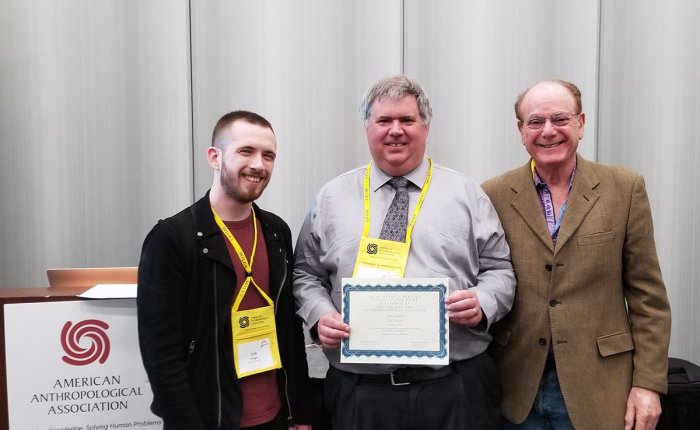
At the 2018 American Anthropological Association meeting, graduate student Erik Ringen won the Society for Anthropological Science’s ‘H. Russel Bernard Graduate Student Paper Prize’ for his paper (co-authored with Pavel Duda and Adrian Jaegi) “Daily food sharing in non-industrial societies: effects of subsistence, socioecology, and phylogeny”. Congratulations!
Photo, left to right: Erik Ringen, Stephen Chrisomalis and H. Russell Bernard
Peter Little’s research is spotlighted in the Chronicle
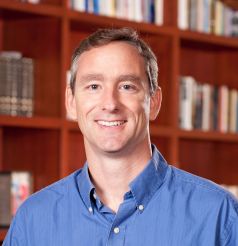
Dr. Little participated in the Happiness and Well-being Project based at Saint Luis University along with over 150 other researchers from 20 nation and spanning multiple fields. The Chronicle Article spotlighted the work done by Dr. Little in collaboration with Workneh Negatu (Agricultural Economics, Addis Ababa University) and Mark Risjord (Philosophy, Emory University), which focused on life satisfaction and well-being in northern Kenya and Ethiopia.
John Lindo’s research is features in the New York Times and Emory Science News Center
DNA analyses show that ancient populations of the Peruvian highlands adapted to the introduction of agriculture and an extreme, high-altitude environment in ways distinct from other global populations. (Emory New Center)
The New York Times published an article about the deductions made by recent DNA research about migrations to and within the Americas, to which Dr. Lindo’s research in the Andes contributed.
Shreyas Sreenath reflects on his fieldwork in a piece titled “Sharing, tasting, and wasting food in our mother tongue”
His contribution published on the Culture and Agriculture section of the American Anthropological Association explores the role our mother tongues play in wasting and sharing food. It reflects on morning municipal sweeping routes and daily garbage hauls in Bangalore, India, occasions when residents interact with sanitation workers by discarding food and sharing leftovers.
“How do our tongues–organs of speech and taste–weave charity into promiscuous expenditure? How might they archive the embodiment and routinization of power?”
Shreyas Sreenath is a PhD candidate in the Department of Anthropology.
Tsering Bum publishes article on “Translating Ecological Migration Policy”
Tsering Bum, graduate student in the Department of Anthropology, publishes his article on “Translating Ecological Migration Policy”.
“This paper analyzes the transmission of China’s environmental policies from the central government down to villages and townships for implementation. It examines the specific ways through which policies are translated from Chinese to other ethnic languages, and communicated to the members of concerned communities. Employing anthropology of policy as an analytical framework, the paper suggests that policies take social life of their own as they are translated into different languages and passed down for implementation through the state bureaucratic apparatus.” Tsering Bum, Emory University
Jessica Thompson’s research is featured on Scienceseen
Scienceseen featured Dr. Thompson’s work in pictures and video, giving a fascinating view into her field work in Malawi. The full story can be found on Instagram.