Anthropology and Human Biology Major Farah Al Chammas is one of four outstanding Emory seniors who will be attending the University of St. Andrews in Scotland on the Bobby Jones Scholarship.
“Emory has changed my life in every possible way and the Bobby Jones Scholarship is ensuring that that continues beyond my time at Emory. [At the University of St. Andrews] I will be pursuing a Masters in International Development Practice, which is an interdisciplinary degree that allows me to enjoy the taste of Emory’s liberal arts nature that I so loved and capitalized on as an undergraduate. It is an honor to be a representative for this institution that has opened my world so I can grow and give back to Emory itself and beyond.”
Left to right: Hannah Katz, Esther Garcia, Klamath Henry (winner of Emory’s Brittain Award, as featured in another post), Sierra Stubbs, Grace Jarrett.
Please join us in congratulating undergraduates Esther Garcia, Grace Jarrett, Hannah Katz, and Sierra Stubbs, and graduate students Andrea Rissing, Christina Rogers, and Adeem Suhail. Undergraduate awards were distributed at the Honors and Awards Luncheon on Friday, April 26. See below for detailed award descriptions. We are so proud of our many talented and engaged students!
Marjorie Shostak Prize for Excellent and Humanity in Ethnographic Writing: Grace Jarrett for her paper “The Hair Salon: A Black Female Geography”
2019 Graduate Student Awards:
Marjorie Shostak Prize for Excellent and Humanity in Ethnographic Writing: Adeem Suhail for his dissertation “THIS IS NOT A GANG: Proxy Classes and Political Subjection in Lyari”
George Armelagos Award for Excellence in Teaching by a Graduate Student: Andrea Rissing and Christina Rogers
Award Descriptions:
Outstanding Senior
For an Anthropology senior who has shown significant achievement in their undergraduate career, both academically as well as through extraordinary engagement and/or service relevant to their study in Anthropology.
Outstanding Junior
For an Anthropology junior who shows great promise at this stage in their undergraduate career, both academically as well as through extraordinary engagement and/or service relevant to their study in Anthropology.
Marjorie Shostak Prize for Excellence and Humanity in Ethnographic Writing
In 1999 The Department of Anthropology announced the establishment of the “Marjorie Shostak Prize” to be awarded each year to an Emory student whose paper reflects original research on some aspect of human life experience. The prize commemorates the life and work of Marjorie Shostak, author of Nisa: The Life and Words of a !Kung Woman (Cambridge, Mass., Harvard University Press, 1981, republished 2000) and the sequel Return to Nisa (Harvard, 2000). These works were highly praised for the immediacy of the writing, the personal character of the ethnographic encounters, and the complete absence of jargon, without any sacrifice of anthropological accuracy or validity. The presence of the ethnographer as an individual in these writings gave the reader an opportunity to take her perspective and biases into account in evaluating the descriptions and interviews.
The award is bestowed on papers/theses that take a direct, personal approach to ethnography, without sacrificing validity or analysis, in keeping with the spirit of Shostak’s work. In the best submissions, human beings will come alive on the page, giving the reader a strong experience of the culture those people belong to. The writer will also attempt to analyze or interpret the experience, but with a minimum of jargon.
George Armelagos Award for Excellence in Teaching by a Graduate Student
This annual award is to recognize graduate students in Anthropology who have demonstrated excellence in undergraduate teaching during their time at Emory. One goal of our graduate program is to develop the teaching skills of all doctoral students. This award is given based on a student’s record in teaching and contributions to the undergraduate program over the entire span of their career at Emory. The award is funded through an endowment set up by the late Professor George Armelagos – a distinguished scholar, teacher, and mentor. It was his desire that the department recognize graduate students who are exceptional teachers, and that this recognition might help them on the job market.
Dr. Knauft presented his work at the biennial conference of the The Society for Psychological Anthropology (SPA) in Santa Ana Pueblo, New Mexico in early April. He explored how the practices of dream yoga and deity-identification among practitioners of Tibetan Buddhism produce qualities of consciousness that Western psychologists have recently recognized as “lucid dreaming.” (Psychology Today)
The Department of Anthropology is thrilled to report that Klamath Henry (19C) is the recipient of the prestigious Marion Luther Brittain undergraduate student award at Emory University. The Brittain Award, generally acknowledged to be the highest honor bestowed on a student by Emory University, is presented each year to two graduating students – one graduate and one undergraduate – from any of the nine academic divisions of the university. These students are considered to have performed the most “significant, meritorious and devoted service to Emory University, with no expectations of recognition or reward.” The award is made under provisions of a gift by the late Dr. M. L. Brittain, former President of Georgia Institute of Technology and an alumnus of Emory.
Klamath’s awards and accomplishments are numerous. This Spring, Klamath was recognized as a “100 Senior Honorary” by the Emory University Alumni Association and as a “2019 Graduating Women of Excellence” by the Center for Women at Emory. Last year she was awarded “Junior Student of the Year,” by the Department of Anthropology. She received a full scholarship for graduate study in Anthropology at the University of California at Fullerton, which she will pursue starting this Fall.
Klamath’s academic research, public scholarship, community work, and personal mission in life is centrally concerned with issues of diversity, inclusion, and representation. Klamath’s own background as a Shasta and Tuscarora woman guides her in this work. The Brittain award serves as a wonderful affirmation that Klamath is making – and has made — a significant and lasting impact on Emory University at many levels, including student life, academic life, our relation to space, and our future as a more engaged ethical community. Her work has been essential in shifting the Emory landscape towards increased representation of Indigenous peoples at Emory. This includes recognition of the Cherokee and Muscogee Creek people who flourished in this region and who took care of this land before the land dispossession and forced removals by the US government in the 1830s.
Just recently, Klamath’s experimental ethnography project – entitled Three Sisters Resiliency — was selected through juried review for inclusion in the annual Screening Scholarship Media Festival at the University of Pennsylvania. The project examines contemporary Indigenous sovereignty in relation to Indigenous food ways.
Klamath is also an accomplished softball player and coach. She has held leadership positions in Residence Life and in liaison with the Dean of Campus Life. In addition, she is the creator of an extensive website and blogspace, entitled “Dancing with Synthetic Moccasins, Native American Engagement at Emory University“, the first website of its kind at Emory University.
Please join us in congratulating Klamath Henry (Anthropology B.A., Environmental Science minor) as the 2019 undergraduate recipient of Emory’s prestigious Brittain award!
On March 21st at the Brownwood Park Pavilion, the Department of Anthropology brought archaeology out of the university and into the community as part of the annual Atlanta Science Festival. In “Become an Archaeologist,” children and parents learned about archaeological science, including how to extract DNA, perform chemical residue analysis, and put together artifacts and bones.
Isabella Alexander is writing a new monthly column for Sapiens called BORDERS. Check out her first article and check back every month for human stories from political crises around the world.
Veatch, a graduate student who researches the environmental context of the Late Pleistocene archaeological site Liang Bua in Indonesia, specifically focuses on the rodent remains found in the cave. She remarks on their diversity as a group of mammals helped by the continuity of bones in the cave sequence, which persist over the 190,000-year stretch preserved in the cave.
Read more about the work of Veatch and other researchers in the National Geographic article.
In her recent Journal on Research in Adolescence review paper Worthman argues that puberty and adolescences should not be split up into bio and cultural but seen as a whole. She emphasizes the importance of improving research in this area due to the large numbers, 17% of the worlds population is aged 10-19 right now, and emphasizes the impact of youth development on mental and physical health.
In this short piece on tasting and speaking with the mother tongue, PhD candidate Shreyas Sreenath explores how organs of social power might inhabit spaces more intimate than we would like to acknowledge. Published in Anthropology news.
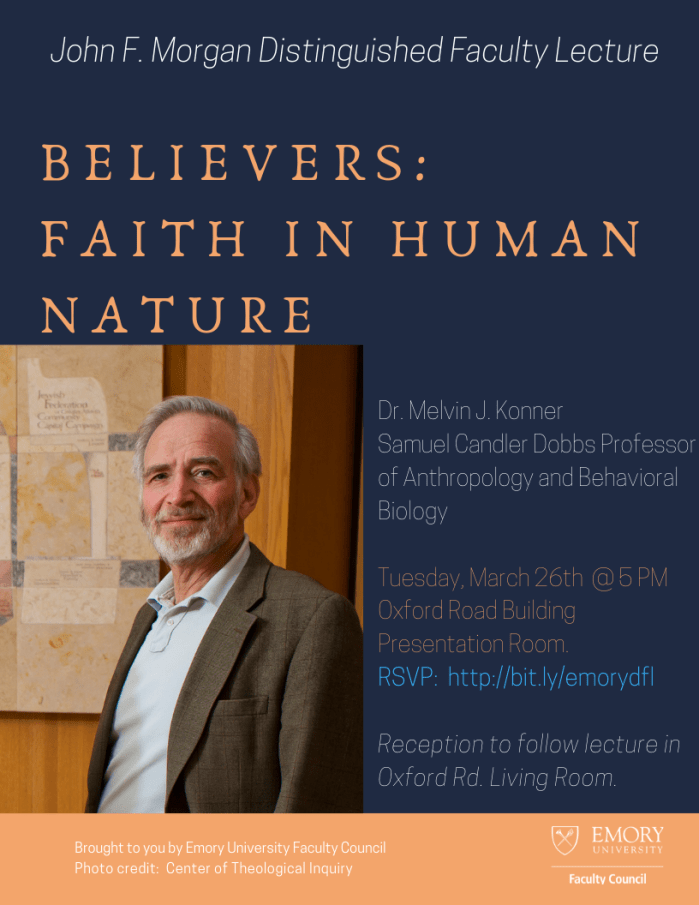
From Emory News: Melvin J. Konner, Samuel Candler Dobbs Professor of Anthropology and Behavioral Biology at Emory, will present this year’s John F. Morgan Sr. Distinguished Faculty Lecture.
Konner will speak on “Believers: Faith in Human Nature,” which is also the title of his forthcoming book, on Tuesday, March 26, at 5 p.m. in the Presentation Room of the Oxford Road Building. RSVP here.

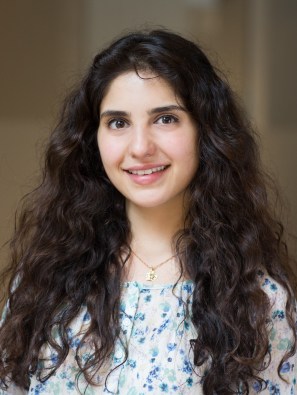 Anthropology and Human Biology Major Farah Al Chammas is one of four outstanding Emory seniors who will be attending the University of St. Andrews in Scotland on the Bobby Jones Scholarship.
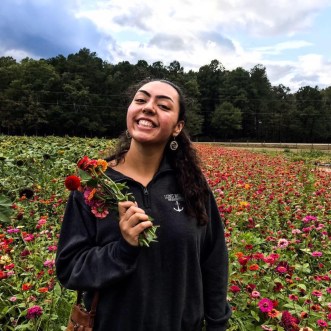 The Department of Anthropology is thrilled to report that Klamath Henry (19C) is the recipient of the prestigious Marion Luther Brittain undergraduate student award at Emory University. The Brittain Award, generally acknowledged to be the highest honor bestowed on a student by Emory University, is presented each year to two graduating students – one graduate and one undergraduate – from any of the nine academic divisions of the university. These students are considered to have performed the most “significant, meritorious and devoted service to Emory University, with no expectations of recognition or reward.” The award is made under provisions of a gift by the late Dr. M. L. Brittain, former President of Georgia Institute of Technology and an alumnus of Emory.
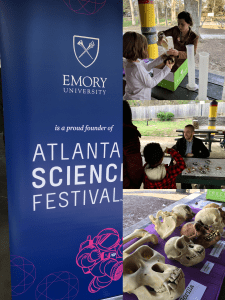 On March 21st at the Brownwood Park Pavilion, the Department of Anthropology brought archaeology out of the university and into the community as part of the annual Atlanta Science Festival. In “Become an Archaeologist,” children and parents learned about archaeological science, including how to extract DNA, perform chemical residue analysis, and put together artifacts and bones.
 Isabella Alexander is writing a new monthly column for Sapiens called BORDERS. Check out her
 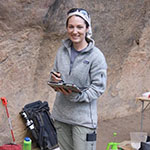 Veatch, a graduate student who researches the environmental context of the Late Pleistocene archaeological site Liang Bua in Indonesia, specifically focuses on the rodent remains found in the cave. She remarks on their diversity as a group of mammals helped by the continuity of bones