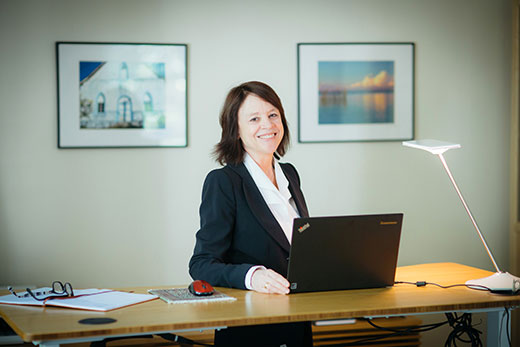
Dr. Dietrich Stout (Emory Anthropology) interviews Dr. Marcela Benitez about her work with Capuchin monkeys and her interest in their social behavior. Dr. Benitez is a postdoc at GA State University and will join Emory’s Anthropology Department as an assistant professor in January 2021.
The Carlos Museum usually offers great activities and events for families on site. With the closure of the galleries due to COVID-19, the museum has been creating online activities for kids and adults.
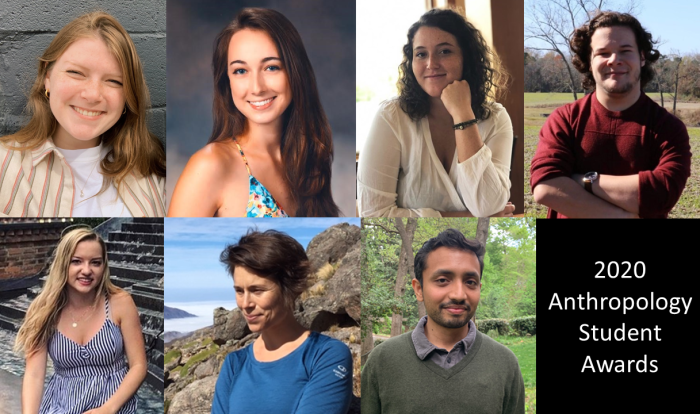
Photo left to right, top to bottom: Isabel Slingerland, Claire Biffl, Emma Hanlon, Evan Amaral, Rebecca Rusnak, Sara Kauko, Shreyas Sreenath.
The Anthropology Department is pleased to announce our 2020 student award winners! Please join us in congratulating undergraduates Isabel Slingerland, Claire Biffl, Emma Hanlon, Evan Amaral and Rebecca Rusnak, and graduate students Sara Kauko and Shreyas Sreenath. Undergraduate awards were conferred at a virtual celebration on Friday, April 24. See below for detailed award descriptions. We are so proud of our many impressive students!
2020 Undergraduate Student Awards
Outstanding Senior Award: Isabel Slingerland
Outstanding Junior Award: Evan Amaral and Rebecca Rusnak
Marjorie Shostak Prize for Excellent and Humanity in Ethnographic Writing:
Claire Biffl for her honors thesis “Experiences of Aging, Kinship, Death, and Independence in an Independent Living Facility”
Emma Hanlon for her honors thesis “Negotiating Spirituality: Ritual, Language, and Space in the First Existentialist Congregation of Atlanta”
2020 Graduate Student Awards:
Marjorie Shostak Prize for Excellent and Humanity in Ethnographic Writing: Shreyas Sreenath for his dissertation “Black Spot: An Account of Caste and Discards in 21st Century Bangalore”
George Armelagos Award for Excellence in Teaching by a Graduate Student: Sara Kauko and Shreyas Sreenath
Top row from left: Naomi Tesema, Riana Peskopos, Rachel Kim, Nora Keatley; middle row: Ru Prasad, Adama Kamara, Sarena Ho, Jahnvi Jain; bottom row: Emma Hanlon, Elisabeth Crusey, Claire Biffl, Dr. Kristin Phillips
The Anthropology department is proud to recognize eleven seniors who successfully defended honors theses, most of them holding defenses remotely and completing their projects from home after the University closed due to the COVID-19 epidemic. Their projects, the culmination of a year (or more!) of independent research and writing, were completed under the supervision of faculty advisors and committee members from within and outside of Anthropology, with support from faculty honors coordinator Dr. Kristin Phillips. These students were honored in a virtual Anthropology Honors and Awards Ceremony on April 24th. One student, Rachel Kim, graduated from Emory in December, and the others are scheduled to graduate with honors on May 11.
Please see below for a full list of theses, and join us in congratulating these students on their hard work and accomplishment!
Claire Biffl – Experiences of Aging, Kinship, Death, and Independence in an Independent Living Facility
Advised by Kristin Phillips
Elisabeth Crusey – “Does anybody have ibuprofen?”: An Investigation of Emory Undergraduates’ Over-the-Counter Analgesic Use
Advised by Bisan Salhi (School of Medicine)
Emma Hanlon – Spiritual Community, Sacred Congregation: Ritual, Discourse, and Space in the First Existentialist Congregation of Atlanta
Advised by Anna Grimshaw
Sarena Ho – Father Absence and Young Adult Romantic Relationship Ideals
Advised by Craig Hadley
Jahnvi Jain – Effects of a Brief Breath Focused Mindfulness Meditation Intervention on Heart Rate Variability and Dissociation in Patients with PTSD and Dissociation
Advised by Negar Fani (School of Medicine)
Adama Kamara – The Politics of Empowerment and Black Female Sexuality: Perceptions Through the Lens of Atlanta’s Trafficking Networks
Advised by Bayo Holsey
Nora Keathley – Latinx Women and Labor in the Digital Age: Exploring Childbirth and Medical Authority Through the Use of YouTube
Advised by John Lindo
Rachel Kim – Representation Matters: Changing Portrayals of Asian-Americans in Hollywood Films from 1993-2019
Advised by Anna Grimshaw
Riana Peskopos – The Queer Female Medical Narratives
Advised by Anna Grimshaw
Ruhika Prasad – Mental Illness and Pregnancy among Women in Mysore, India: Health Provider and Women’s Perspectives
Advised by Joyce Flueckiger (Religion)
Naomi Tesema – Mobile Phone Apps for HIV Prevention Among College-Aged Black Women in Atlanta: Preferences and Prototype
Advised by Rasheeta Chandler (Nursing) and John Lindo
A list of all previously completed Anthropology honors theses is available at
In his interview with the BBC Dr. James Rilling presents his research on hormonal and neural changes men experience during fatherhood, including lower testosterone and higher oxytocin during early fatherhood.
The interviews with Dr. Rilling and other experts in the field covers the topic of fatherhood and its challenges broadly, listen to the full interview online.
Scott Schnur sits down with Dr. Elizabeth Emma Ferry (Brandeis University) to discuss how to creatively teach anthropological theory in graduate school. They discuss how course design can help students better engage with theory in order to reform the discipline and think creatively. Read the publication on the website of the Society for Cultural Anthropology.
The Netflix show “Babies” featured Michelle Lampl as one of over 30 scientists. The docuseries about the first year in an infant’s life included Lampl’s research on growth spurts as part of Episode 3.
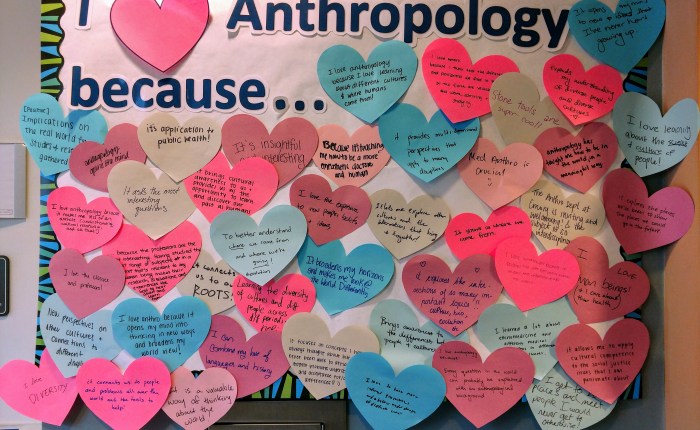
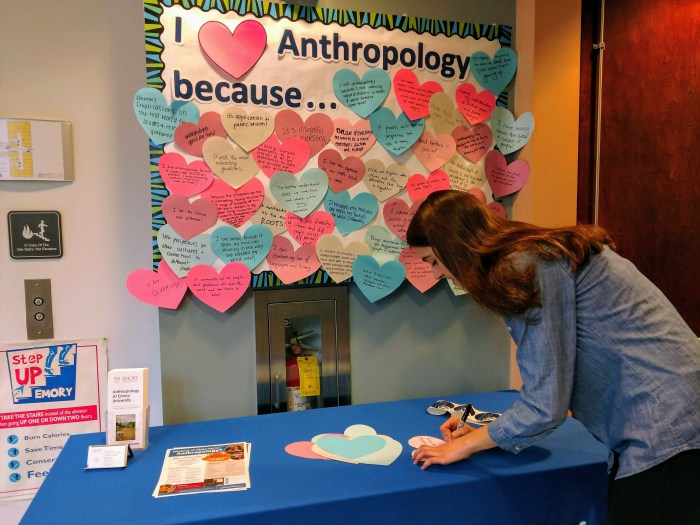
The American Anthropological Association (AAA) designates the 3rd Thursday of February as Anthropology Day, a day to “celebrate what Anthropology is and what it can achieve” while “sharing it with the world around us.” Emory Anthropology students stopped by today to share what they love about Anthropology, which included things like:
“It focuses on concepts I have always thought about but have never been able to articulate. Anthro promotes understanding and acceptance for/of differences!”
“It allows me to apply cultural competence to the social justice issues that I am passionate about.”
“I love anthro because it opens my mind into thinking in new ways and broadens my world view!”
“It connects us to our ROOTS!”
“Because it’s teaching me how to be a more empathetic doctor and human.”
“It provides multi-dimensional perspectives that apply to many disciplines.”
“Anthropology has taught be how to be in the world in a meaningful way.”
We love to see how studying anthropology allows our students to feel more connected to each other and the world, while focusing on a broad range of interests and applications. Whatever our specific goals and inspirations, we all believe in the power of anthropology to help make the world a better place! #AnthroDay
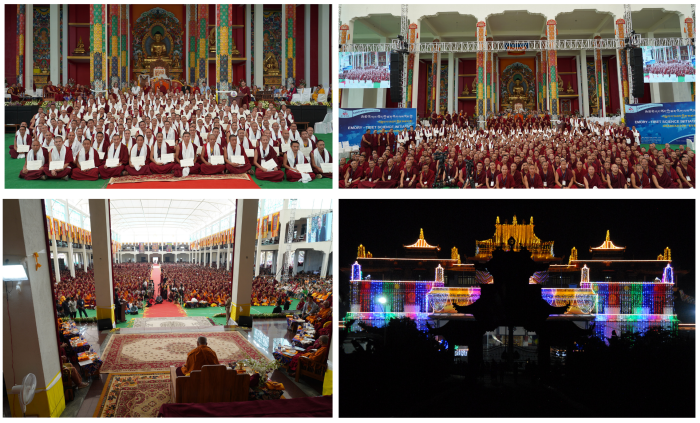
Since 2007, Emory University has partnered in the Emory-Tibet Science Initiative (ETSI) with His Holiness the Dalai Lama and the Tibetan Buddhist community, to realize their vision to incorporate science into the monastic curriculum. Emory Anthropology Department professor Carol Worthman has spearheaded the neuroscience track from its inception, orchestrating a 6-year curricular development and pilot phase, and then implementing it at the 3 biggest monastic universities in south India. “In December, 2019, we celebrated the successful roll-out of the entire 6-year ETSI curriculum in the monasteries at a gathering with His Holiness, the monastic community, and ETSI leaders in Mundgod, India. We also graduated the first cohort of monastics to complete the 6-year program. These were historic undertakings for the monastic community, and especially for monastic students and the many senior monastics who work to realize the goal of monastic science education and already are productively exploring fresh ideas and insights from these distinctive perspectives.” (Carol Worthman)
The events not only celebrated ETSI milestones, but also inaugurated a new debating hall at one of the big monasteries and, most importantly, marked a 600th anniversary of Je Tsongkhapa, founder of a major school of Tibetan Buddhism to which His Holiness belongs. Photos show the interior of the vast new debate hall, celebration of graduating classes, and presentations by Worthman of reflections and the neuroscience books ETSI has produced. Also included is a view of Drepung Loseling prayer hall (the Dalai Lama’s home monastery), where ETSI were held for the first 3 years until a large science center was built. The photo of illuminations at Drepung honoring the anniversary show that monastics really know how to celebrate!








 EMORY ANTHROPOLOGY