The Anthropology Department announces Student Award Winners

The Anthropology Department is pleased to announce the 2018 student award winners!  Undergraduate awards were distributed at the Honors and Awards Luncheon on Friday, April 27. Full award descriptions are included below. We are so proud of our many impressive and engaged students!

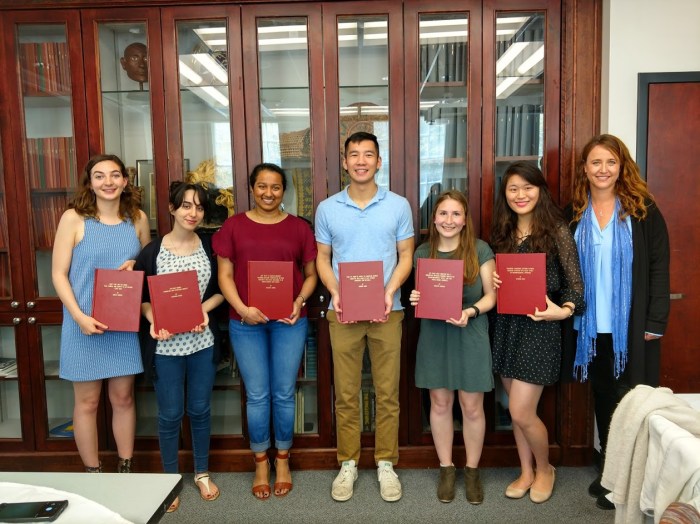
Honors Awards Luncheon 2018 - awards.jpg

Left to right: Becky Lebeaux, Diana Cagliero, Klamath Henry, Aditi Majoe, Amelia Howell

2018 Anthropology Student Awards

Undergraduate

  • Outstanding Senior Award: Diana Cagliero
  • Outstanding Junior Award: Klamath Henry and Aditi Majoe
  • Trevor E. Stokol Award for Outstanding Research: Rebecca Lebeaux for her honors thesis project “100 Years Later: Modeling Why a Modern-Day Influenza Pandemic Would Still Disproportionately Affect Low and Middle-Income Countries”
  • Marjorie Shostak Prize for Excellence and Humanity in Ethnographic Writing: Amelia Howell for her honors thesis project “Booty Hop and the Snake: Race, Gender, and Identity in an Atlanta Strip Club”

Graduate

fenton 14.jpgsalhi-bisan.jpgsilverstein-2014.jpg

Left to Right: Ioulia Fenton, Bisan Salhi, Syndey Silverstein

  • Marjorie Shostak Prize for Excellence and Humanity in Ethnographic Writing: Bisan Salhi, for her dissertation “Diagnosis Homeless: Emergency department ‘super-utilizers’ and urban poverty in Atlanta, Georgia”, and Sydney Silverstein, for her dissertation “What Comes Between Coca and Cocaine: Haunted Boundaries and Troubled Transformations in the Peruvian Amazon”.
  • George Armelagos Award for Excellence in Teaching by a Graduate Student: Bisan Salhi and Ioulia Fenton


Award Descriptions:

Outstanding Senior

For an Anthropology senior who has shown significant achievement in their undergraduate career, both academically as well as through extraordinary engagement and/or service relevant to their study in Anthropology.

Outstanding Junior

For an Anthropology junior who shows great promise at this stage in their undergraduate career, both academically as well as through extraordinary engagement and/or service relevant to their study in Anthropology. 

Trevor E. Stokol Award for Outstanding Undergraduate Research

Funded by multiple donors, the Trevor E. Stokol award honors the life of Trevor Stokol, an Emory anthropology undergraduate who was preparing to enter medical school when he went missing on Mt. Everest in July 2005. The Stokol award is made annually to an Emory undergraduate student with the best senior research project that may include a Senior Honors Thesis. A memorial for Trevor stated: “Trevor Eric Stokol died “living his dream” with camera in hand near Mt. Everest Base Camp in Nepal. Tenacious and resilient, strong physically, emotionally and in truth, he lived an impassioned and full life. Trevor was a graduate of RMA and Emory University and was about to start medical school, no doubt to serve the disadvantaged. He lived his 25 years with gusto, knew no stranger and died at peace with himself and the world around him.”

Marjorie Shostak Prize for Excellence and Humanity in Ethnographic Writing

In 1999 The Department of Anthropology announced the establishment of the “Marjorie Shostak Prize” to be awarded each year to an Emory student whose paper reflects original research on some aspect of human life experience.  The prize commemorates the life and work of Marjorie Shostak, author of Nisa: The Life and Words of a !Kung Woman (Cambridge, Mass., Harvard University Press, 1981, republished 2000) and the sequel Return to Nisa (Harvard, 2000). These works were highly praised for the immediacy of the writing, the personal character of the ethnographic encounters, and the complete absence of jargon, without any sacrifice of anthropological accuracy or validity. The presence of the ethnographer as an individual in these writings gave the reader an opportunity to take her perspective and biases into account in evaluating the descriptions and interviews.

The award is bestowed on papers/theses that take a direct, personal approach to ethnography, without sacrificing validity or analysis, in keeping with the spirit of Shostak’s work. In the best submissions, human beings will come alive on the page, giving the reader a strong experience of the culture those people belong to. The writer will also attempt to analyze or interpret the experience, but with a minimum of jargon.

George Armelagos Award for Excellence in Teaching by a Graduate Student

This annual award is to recognize graduate students in Anthropology who have demonstrated excellence in undergraduate teaching during their time at Emory. One goal of our graduate program is to develop the teaching skills of all doctoral students.  This is part of our requirements for the PhD and is actualized through the LGS TATOO program, required teaching assistantships and the teaching roundtables.  This award is given based on a student’s record in teaching and contributions to the undergraduate program over the entire span of their career at Emory.  The award is funded through an endowment set up by the late Professor George Armelagos – a distinguished scholar, teacher, and mentor.  It was his desire that the department recognize graduate students who are exceptional teachers, and that this recognition might help them on the job market.

Anthropology Photo Contest Winners Announced

Congratulations to the winners of the Anthropology Photography contest!

First Prize: Amelia Howell
Dog.jpeg

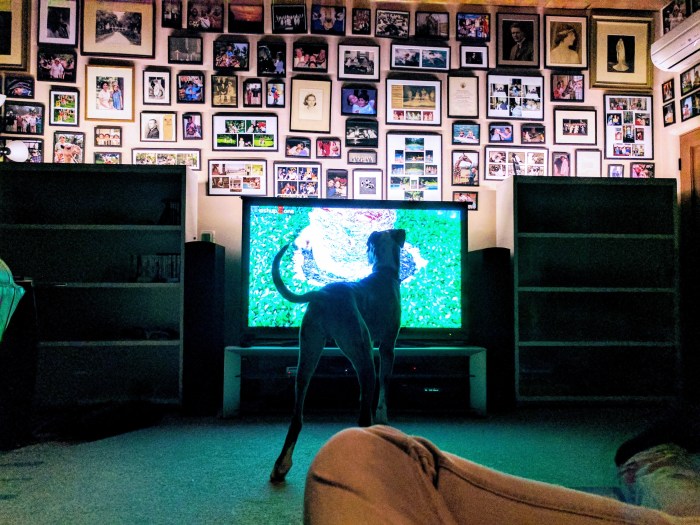
Amelia is a graduating senior and an Anthropology major. This year, she wrote an honors thesis called, “Booty Hop and the Snake: Race, Gender, and Identity in an Atlanta Strip Club,” for which she also won the Undergraduate Shostak Award for Excellence and Humanity in Ethnographic Writing. The award winning photograph is called “Everything in Excess.”

Everything in Excess 

This photo is of my family’s Great Dane, Yeagar, blocking the flat screen television in our game room. Behind the dog is a wall of photos from family trips all over the world from when we were children. This photo emphasizes an aspect of the culture of wealth in the United States. Everything in this photo is in excess. The size of the dog, the size of the television, and the size of the wall covered in photographs from around the world. The irony of this image is that the excessiveness of the size and wealth in the foreground is contrasted with the images on the wall which display family trips to predominantly less affluent areas of the world in Kenya, Tanzania, Liberia, Mexico, and Israel. The wall offers a glimpse of other realities of the world while being displayed among the comfort of an upper middle class family in the U.S. This image speaks to the culture of wealth in the United States where people often display said wealth through conspicuous consumption but also through displaying mementos representing the contrast in economic status of the reality of majority of the world.


Second Prize: Aiman Mustafa
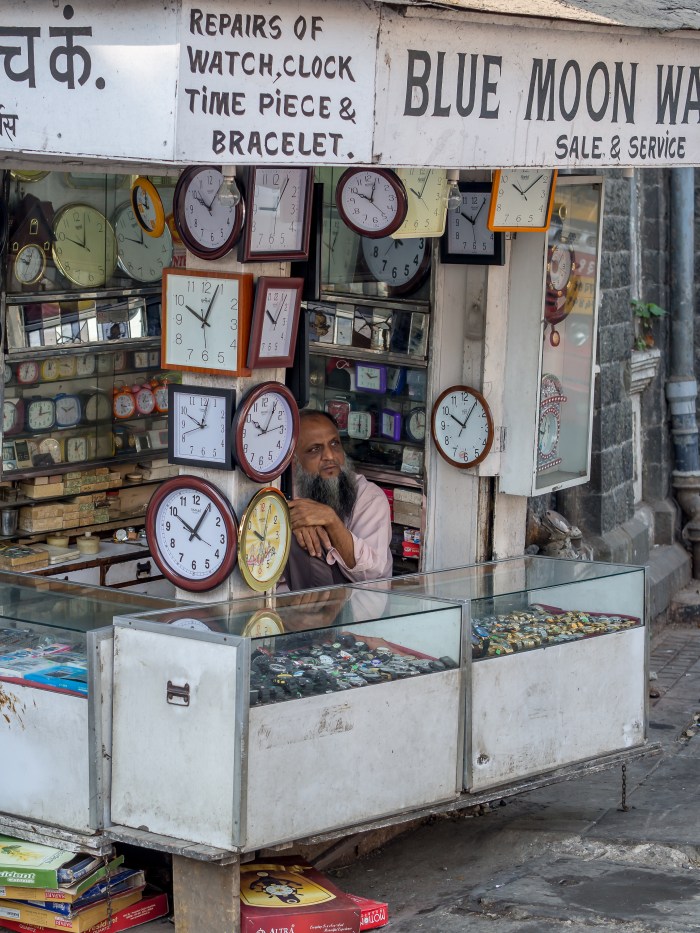
photo 2.jpg

Aiman has recently returned from fieldwork in India for his dissertation, “The Elusive Community: The Making and Unmaking of Muslim Minority Voices in Mumbai, India: An Ethnographic Account.” The second place photo was taken in Mumbai.

Who – The owner and his watch shop     What – Waiting for customers   When – 24 December 2016    Where – Opposite the bustling CST terminus (formerly Victoria Terminus) a World Heritage site and tourist hotspot, Mumbai, India

The picture captures a moment in this watch shop owner’s tiring wait for customers amidst the bustling environs of the World Heritage site. With the availability of cheap mobile phones mostly made in China most people have stopped using watches and clocks to keep time and small businesses such as this one are struggling to stay afloat.


Third Prize: Sarah Whitaker
Salar de Uyuni 200 dpi.jpg

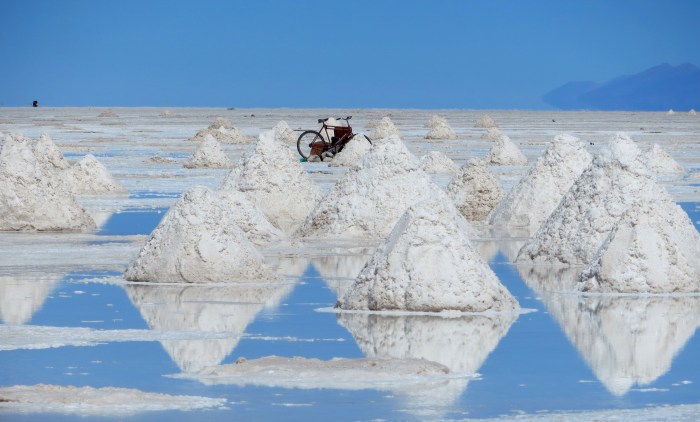
Sarah is currently conducting fieldwork in the Italian Alps for her dissertation, “Climate Change and Well-being in the Italian Alps.” Her third prize photo similarly displays her interests in climate and human interactions with the environment.


The photo captures a bike in the middle of the 4000 square mile Salar de Uyuni in Bolivia, the largest salt flat in the world. The photo suggests the presence and activity of humans in an otherwise empty and seemingly inhospitable landscape. People from nearby towns arrive by bike, foot, or truck to harvest the salt, which they collect into small piles and then transport out of the flats. The Salar is an important international source of salt and the mineral lithium, used to treat bipolar and to make electric car batteries, smartphones, and fertilizers. Bolivian president Evo Morales has promised to develop the extraction of minerals from the flats to meet worldwide demand. While increased extraction would bring more jobs and much needed economic growth to the area around the Salar, local residents worry about the environmental impact and the impact on tourism. The flats are a major tourist destination, a stop on the “gringo trail” through South America. The future of the flats remains uncertain as international, national, and local political, social, and economic interests and opinions continue to clash, some people wanting to push forward, others not wanting the Salar to change. In the meantime, local residents continue to ride their bikes into the flats, harvest its salt and show tourists its beauty, and make a living off a harsh landscape that has remained unchanged for centuries.


People’s Choice: Kaitlin Banfill

Kaitlin is currently conducting fieldwork in China, for her dissertation, “Clans and Classmates: Kinship, Migration, and Education in Southwest China.” Her photo was chosen by those who visited the exhibit and voted for their favorite.
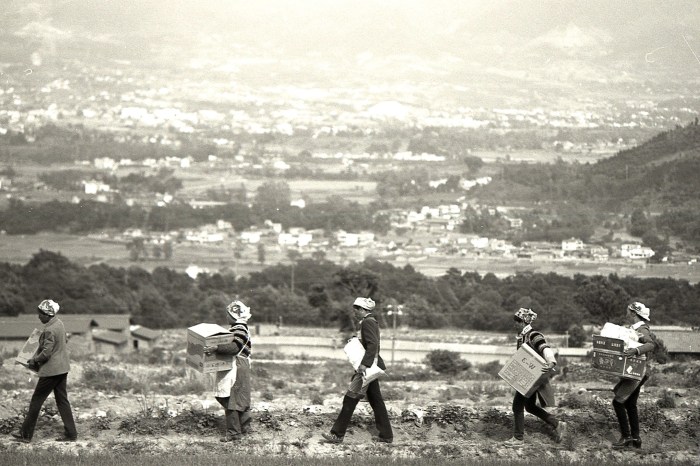
KB1.jpgSichuan Province, China , 35mm black and white film

A Nuosu funeral in Dechang County. In Nuosu culture, funerals are more important than births or weddings, and they bring relatives and community members together. In this photo, women prepare fireworks to guide the funeral procession and the deceased’s soul down the “road of spirits.” This photo is “anthropological” because it shows the relationships between the living and the dead, who continue to live through constant cultivation and reinvention of the community.

Thank you to everybody who participated!

ANT 385: Anthropology & Performance culminates in Ethnographic Theater Showcase

ANT 385: Anthropology & Performance culminates in Ethnographic Theater Showcase

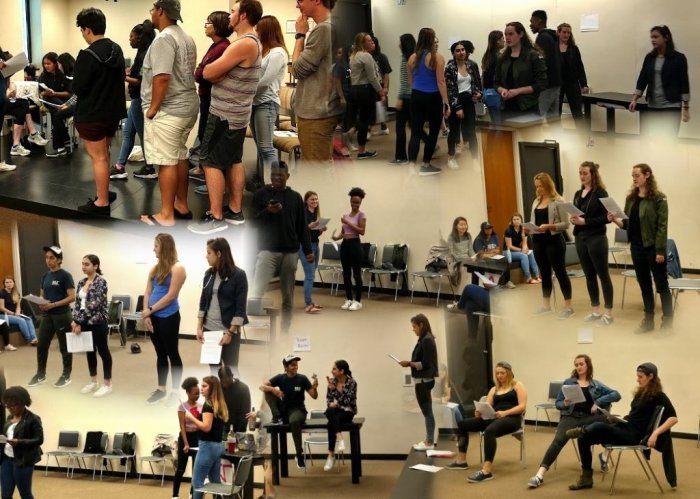
What does the research-to-stage process look like?  And why does it matter?  Last week the students in Prof. Debra Vidali’s “Anthropology & Performance” class presented a dynamic showcase of ethnographic theater projects, based on original research.   Students transformed over 100 hours of research interviews and extensive participant-observation research into verbatim documentary theater performances that examined issues of well-being, diversity, belonging, race, ethnicity, gender, sexuality, and birth control.  The vivid portrayals brought to light issues and voices that are less well understood and represented, and sparked a lively audience discussion about future applications and interventions.

ShowcaseCollage

Klamath Henry (19C) Produces Website On The Resiliency of the Three Sisters Crop

Klamath Henry (19C) Produces Website On The Resiliency of the Three Sisters Crop

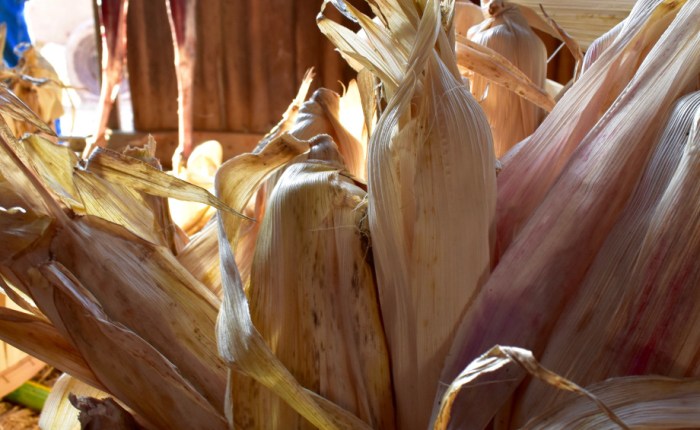
Klamath Henry, a junior anthropology major (B.A.), published a website in the fall of 2017 on her ANT497R research, advised by Dr. Debra Vidali. This research looks at the resiliency of the Iroquois Three Sisters food system and its impact on the Tuscarora Indian community. The website showcased findings in her research, and includes self produced poetry, photography, resources, quotations and a short video.

“The resiliency of North American Indigenous food groups through forced assimilation and colonization is incredible. I was fortunate enough to have had the opportunity to take research credit to investigate my tribe’s traditional ways of producing food, and produce a website to showcase my findings for both my tribal community and the greater public. It is important that universities take the time to decolonize their ways of thinking about research, because in doing so, they allow for the erased voices of Indigenous peoples to be heard,” says Henry.

“Naming the Forty-Seven.” Isabella Alexander (PhD 2016) puts names and faces to anonymous migrants drowning at sea

“Naming the Forty-Seven.” Isabella Alexander (PhD 2016) puts names and faces to anonymous migrants drowning at sea

“What if we started reporting tragedies in the Mediterranean like we do any others – with names and not numbers? There were forty-seven humans lost in a single shipwreck. This isn’t the story of their shipwreck. It’s the story of them,” says Isabella Alexander (PhD 2016) .

Dr. Alexander writes about her work to identify the migrants who died when their boat capsized on February 4th while trying to reach Europe. She has become an expert on the migrant crisis through the research for her documentary The Burning: An Untold Story from the Other Side of the Migrant Crisis.

Happy Anthropology Day!

Happy Anthropology Day!

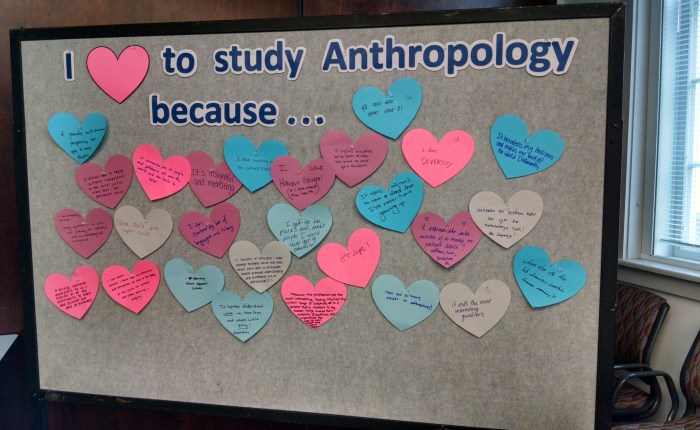
Happy #AnthroDay!  Emory undergraduate students, graduate students, and faculty gathered this afternoon to enjoy donuts and enlightening conversation with our fellow Anthropologists.  We had a great turnout, and a number of students contributed to our board by completing the sentence “I [heart] to study Anthropology because…”  Whatever the different reasons that inspire us, we all share a love for Anthropology!

Andrea Rissing explores the ethnographically generative practice of “flipping the field” in Anthropology News

Andrea Rissing explores the ethnographically generative practice of “flipping the field” in Anthropology News

Graduate student Andrea Rissing publishes article in Anthropology News describing the approach to her research on Iowa farms, which includes letting the farmers contribute questions they feel are worth asking.

“I always found that farmers had insightful opinions on what questions merited investigation. People know what is important in their own lives, and creating space for them to flip the interview made for more interesting, dynamic research.”

Isabella Alexander’s (16PhD) class is featured on Emory News

In Anthropology 385: The Migrant and Refugee Crisis Isabella Alexander combines classroom learning with creation of real-life solutions. Students interacted with people affected by the migrant crisis and created final projects that are aimed at having genuine impact, such as a mentoring program for young refugees.

“To the students, it was a heady experience, steeped in the thrill of identifying a problem and actually doing something about it. For their professor, it was an affirming case study in the power of engaged learning.” Emory News Center


Grace Veatch is interviewed by Sapiens

“What do giant rats and tiny ‘Hobbits’ have in common? They both lived on a tiny island in Indonesia and form an important piece of the puzzle for uncovering what it means to be human.”

Homo floresiensis rat bones - Veatch examines a “hobbit,” or Homo floresiensis, skull from Liang Bua Cave.

This is the focus of Grace Veatch’s dissertation research, as she analyzes thousands of tiny and giant sized rat bones that were recovered in a cave site along with a human ancestor named Homo floresiensis.

“I hope to understand how these ‘Hobbit’s’ incorporated small mammals into their diet, and how this might compare to how modern humans also use this vital resource on an island depauperate of large game. Check out my research showcased in an online article through Sapiens.org for more information about this exciting research happening here in the Anthropology Department at Emory University.”


Aubrey Graham (PhD 2016) is featured in The Harvard Humanitarian Initiative

Aubrey Graham (PhD 2016) is featured in The Harvard Humanitarian Initiative

Aubrey P. Graham’s (PhD 2016) photographic exhibition created in coordination with the Harvard Humanitarian Initiative will hang in the Harvard Asia Center from Nov. 2- 30, 2017. “High Ground: Disaster, Risk, and Resilience in the Philippines” explores the social dynamics that affect disaster preparedness across two distinctive communities: Sitio Kislap and Gawad Kalinga.

High Ground: Disaster Risk and Resilience in the Philippines Photo Exhibition

Q&A with Dr. Aubrey Graham, Photographer of “Disaster, Risk, and Resilience in the Philippines” Exhibit

APGRAHAM GK Small Leticia HHI