
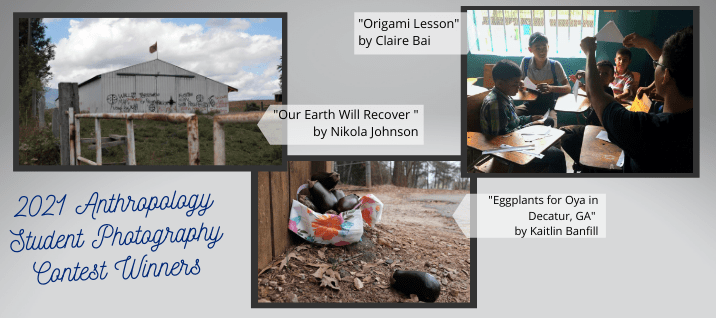
Congratulations to our Contest Winners!
- “Our Earth Will Recover” by Nicola Johnson
- “Origami Lesson” By Claire Bai
- “Eggplants for Oya in Decatur, GA” by Kaitlin Banfill

The Anthropology department is proud to recognize our 2021 honors graduates: Margot Bailowitz, Olivia Blackman, Isabella Cantor, Makda Mulugeta, and Anna Wachspress. In a year which presented unusual research challenges, these students persevered with creativity and resourcefulness, completing rich projects on topics ranging from Native American COVID-19 campaign artwork to the experience of couples aging together in assisted living. One project, a documentary film following an Atlanta-based civil rights organization, was the first film-based project to be completed in the Anthropology department. All projects were completed under the supervision of faculty advisors and committee members from within and outside of Anthropology, with support from faculty honors coordinator Dr. Debra Vidali. These students were honored in a virtual Anthropology Honors and Awards Ceremony on May 3rd, and graduated with honors at the Emory College graduation ceremony on Sunday, May 16.
You can read more about this year’s honors students and their projects at http://anthropology.emory.edu/home/undergraduate/opportunities/honors-2021.html. Please join us in congratulating these students on their hard work and accomplishment!
The Anthropology Department is pleased to announce our 2021 student award winners! Please join us in congratulating undergraduates Isabella Cantor, Katherine Morgan, William Johnson, and Phoebe Einzig-Roth, and graduate students Elena Lesley and Luisa Rivera. Undergraduate awards were conferred at a virtual celebration on Monday, May 3.

2021 Undergraduate Student Awards
Outstanding Senior Award: Isabella Cantor and Katherine Morgan
Outstanding Junior Award: William Johnson
Marjorie Shostak Award for Excellence and Humanity in Ethnography
2021 Graduate Student Awards:
George Armelagos Award for Excellence in Teaching by a Graduate Student: Elena Lesley and Luisa Rivera
For award descriptions and past winners, visit our Departmental Awards webpage.

Goodrich C. White Professor Emerita Peggy Barlett was recently honored during the Emory Office of Sustainability Initiative’s Virtual Earth Day Celebration with a Lifetime Achievement Award. Prof. Barlett has served on the faculty of the Department of Anthropology at Emory since 1976. In her tribute to Prof. Barlett, who retired in Summer 2020, Prof. Bobbi Patterson highlighted Prof. Barlett’s many contributions to Emory’s national leadership in campus sustainability, her service to students, and her numerous academic accomplishments.
From Professor Barlett’s innumerable contributions to the field and practice of sustainable food, her ignition of long-term commitments to sustainability among Emory faculty through her creation of the Piedmont Project, and her path-breaking leadership on behalf of women faculty at Emory, her impact has been immeasurable.
At the same event, Anthropology staff Eva Stotz was named Outstanding Sustainability Representative. Prof. Bobbi Patterson (Religion) and Prof. Eloise Carter (Biology – Oxford) were also honored with Sustainability Lifetime Achievement Awards. Videos of the event are available online.
Focusing on pastoralism, this article reflects on five diverse cases across Africa, Asia and Europe and asks: how have COVID-19 disease control measures affected mobility and production practices, marketing opportunities, land control, labour relations, local community support and socio-political relations with the state and other settled agrarian or urban populations? In response to the lockdown measures, the article explores what innovations have emerged to secure livelihoods, through new forms of social solidarity and ‘moral economy’. The cases examine how impacts and responses have been differentiated by class, age, wealth and ethnicity, and explore the implications for socio-economic processes and political change in pastoral settings.
The article is availabe online, full list of the authors and publication details: Simula, Giulia, Bum, Tsering, Farinella, Domenica, Maru, Natasha, Mohamed, Tahira S., Taye, Masresha, Tsering, Palden. 2020. COVID-19 and Pastoralism: Reflections from Three Continents. The Journal of Peasant Studies 48(1): 48-72.

Carol Worthman, Samuel Candler Dobbs Professor Emerita of the Department of Anthropology, has received the 2021 Society for Psychological Anthropology Lifetime Achievement Award. The award “honors career-long contributions to psychological anthropology that have substantially influenced the field and its development. The award seeks to recognize the work of individuals whose sustained involvement in psychological anthropology has had a major impact on research directions, on the wider visibility and relevance of the field, and on the growth of a community of scholarship addressing issues of culture and psychology.“
Professor Worthman integrates anthropology, human development, and neuroscience to investigate the bases of differential well-being with a particular focus on adolescent and global mental health. She has conducted collaborative biocultural and biosocial research in thirteen countries, including Kenya, Tibet, Nepal, Egypt, Japan, Papua New Guinea, Vietnam and South Africa, as well as in rural, urban, and semi-urban areas of the United States.

Dr. Ozawa-de Silva published her research in Sage Journals along with her co-author Michelle Parsons.
Loneliness has been increasingly recognized as a public health issue rather than merely an individual psychological issue, as the appointment of the UK’s very first Minister of Loneliness in 2018 shows. In recent months, the COVID-19 pandemic has highlighted our need for social connection. Technology has allowed many of us to connect even when we are physically remote. Our need to connect with others is the very thing that creates the potential for loneliness. For this reason, loneliness should not be pathologized as a disorder, but rather seen as a natural expression of what it means to be a social being, born into and existing within a society. This does not mean that loneliness is experienced in the same way everywhere. As the papers in this special issue, “toward an anthropology of loneliness” amply illustrate, culture shapes expectations, experiences and expressions of loneliness.
Following this publication from 2020 is the Podcast on loneliness and the special issue Toward an Anthropology of Loneliness (Ozawa-de Silva and Parsons, 2020), Transcultural Psychiatry Podcast, 22, February.
Willen, associate professor at UConn, established the Pandemic Journaling Project along with Katherine Mason, Assistant Professor at Brown University. In addition to giving a voice to people from different areas and backgrounds, this project will create records of how people felt throughout this historic event. In the New York Times article Willen and Mason voice some of their early analysis.
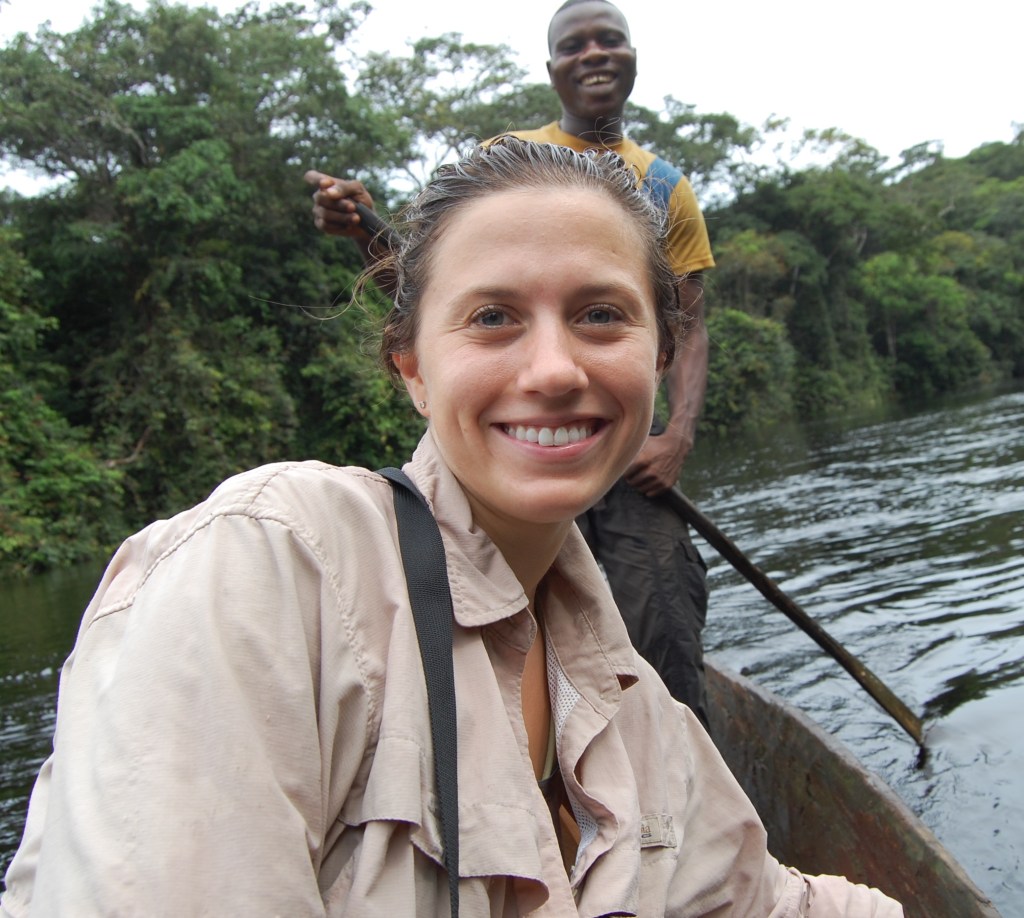
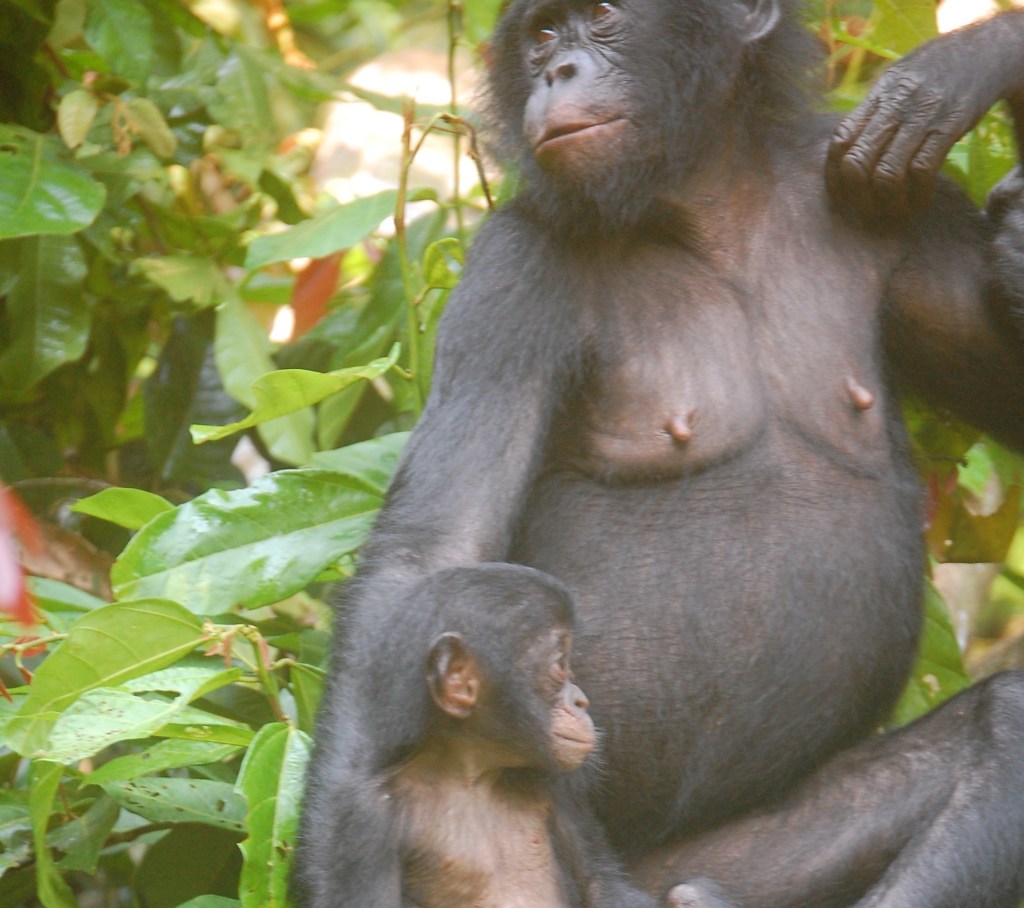
Sarah Kovalaskas joined the Department of Anthropology as a graduate student in 2018 and recently published a paper titled “Comparative analyses of the Pan lineage reveal selection on gene pathways associated with diet and sociality in bonobos” in the journal Genes, Brain and Behavior. Second and third authors are Jim Rilling, professor and department chair at Emory’s Department of Anthropology, and John Lindo, assistant professor at Emory’s Department of Anthropology.
“I feel like this paper was a great example of seizing an idea and making use of already existing data in that all the genomes are all publicly available online and we just needed the storage space and computational know-how to carry it out. The idea of ‘self domestication’ is something that I’ve been interested in and thinking about for a while, and I was hoping to work on similar topics for my dissertation. Even though I’m going in a different direction now it was a really nice way for me to build relationships with professors in the department after Adrian Jaeggi left Emory to continue his research at the University of Zurich. It also allowed me to dip my toes into other fields (genomics) and see how I could incorporate those techniques with my own interests and background working in the field with bonobos.”
While there has been a lot of research about how motherhood affects women, Dr. Rilling has been working to fill the gap by researching the effects of fatherhood on men. In the article he explains the effects of testosterone on the behavior of avian, primate, and human fathers, as well as his research on the effect of fatherhood on testosterone levels in men.
https://aeon.co/essays/how-raising-children-can-change-a-fathers-brain

